Managing time zones with African developer teams: the practical playbook
Master managing remote developers in Africa with our playbook. Learn to turn 3-4 hours of overlap into a competitive edge using async-first workflows.
 Victoria OlajideProduct & Content Marketing at Devcenter
August 4, 2026 · 7 min read
Victoria OlajideProduct & Content Marketing at Devcenter
August 4, 2026 · 7 min read

Time zones are the most cited objection to hiring African developers. They are also the most overstated. Companies that have done it successfully follow a small set of structural decisions that convert a potential coordination problem into a genuine competitive advantage. This guide covers exactly those decisions.
The Actual Timezone Picture
Before building a workflow, you need accurate numbers. Most discussions of African hiring exaggerate the time zone problem by lumping all of Africa together. The continent spans four time zones, and the ones that matter for developer hiring have very different overlap profiles.
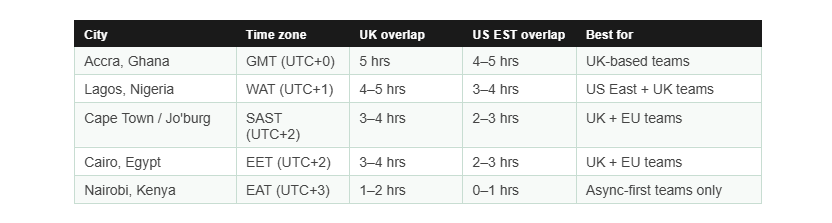
The practical takeaway: West Africa (Lagos, Accra) is the right hiring geography for most US and UK companies. South Africa and Egypt are excellent for UK and European teams. Nairobi works for teams that have already built strong async disciplines and don't need real-time overlap for daily work. For a deeper breakdown of what each African tech hub offers beyond time zone alignment — including stack depth, ecosystem maturity, and hire-here recommendations — see our guide to the top 5 tech hubs in Africa.
What 3-4 hours of overlap actually gives you
The instinct is to think 3-4 hours is not enough. In practice, it's sufficient for everything that genuinely requires real-time communication in software engineering. According to GitLab's 2022 Remote Work Report, async-first distributed teams consistently outperform co-located teams on delivery velocity when workflows are structured around documentation, written updates, and deliberate synchronous touchpoints.
Here is what fits inside a 3–4 hour overlap window:
- Daily standup (15 minutes): set priorities, surface blockers, confirm alignment
- Code review discussion (30–60 minutes): walk through a PR together when the review needs real-time conversation
- Sprint planning or retro (60–90 minutes): structured agenda, decisions documented in real time
- Incident response: the overlap covers the handoff and initial triage; most production incidents have resolution windows longer than 4 hours
Everything else: writing code, reviewing PRs, writing documentation, addressing tickets, running tests, is inherently asynchronous. The 3–4 hour window is not a constraint on engineering output; it's a scheduling constraint on a small number of synchronous touchpoints.
The Async-First Structure That Works
Companies that manage African developer teams well share one structural principle: they design for async by default, and treat synchronous time as a scarce resource to be spent deliberately. This is the correct mental model for any distributed team, not just African hiring.
1. Written daily updates replace status meetings
Each developer posts a short written update at the start or end of their working day: what was completed, what is in progress, and any blockers. This takes 5 minutes and replaces a 30-minute status meeting. Tools: Slack (dedicated daily-update channel), Linear (status fields), or a simple Notion template.
2. Async video for walkthroughs that would otherwise be meetings
Loom or equivalent tools let developers record a 5-minute walkthrough of a new feature, an architectural decision, or a code change. The recipient watches when convenient, comments asynchronously, and responds in kind. Teams that adopt async video walkthroughs for architecture reviews and feature demos consistently report fewer meetings and more deep-work time — the two variables that most directly affect engineering output quality.
3. Documented decisions, not just meeting notes
Every non-trivial decision gets a brief written record: what was decided, why, and who is accountable. This is the single practice that most prevents the "I thought we agreed" problem across time zones. It also creates a permanent record that new team members can consult rather than having to chase colleagues.
4. Set clear response SLAs
Ambiguity about response times is what actually slows distributed teams down, not the time zones themselves. Establish and communicate:
- Urgent (production incident): respond within 2 hours during working hours
- Operational (code review, PR feedback): respond within 24 hours
- Strategic (architecture review, RFC): respond within 48–72 hours
These SLAs align expectations, reduce anxiety about silence, and let engineers do deep work without the pressure of always being "on."
Want a shortlist of African developers already experienced with async-first, distributed team workflows?
Gigson vets for both technical skill and communication quality — including async documentation standards and response clarity.
-> Browse vetted developers or get a managed shortlist
The meeting structure that actually works across time zones
Not all synchronous time is equal. The following structure has been validated across Gigson's 100+ client companies hiring African developers:
Use the overlap window for one short daily standup. Keep it under 15 minutes. Use a structured format: done, in progress, blocked. Rotate who facilitates. Record it for team members who couldn't attend. This single meeting, done well, is sufficient to maintain daily alignment across a distributed team.
Sprint ceremonies: schedule during overlap, record everything
Sprint planning, review, and retrospective all fit within a 60–90 minute window that should be scheduled during the overlap period. Use shared collaborative tools (Miro, Notion, Figma) during these sessions so everyone can contribute in real time. Record the session. Publish a summary with decisions and action items within 24 hours.
Rotate inconvenient meeting times fairly
When a required meeting falls outside the overlap window, rotate whose time zone bears the inconvenience. If the UK team takes the late-afternoon hit this sprint, the Lagos team takes it next sprint. This is a basic fairness principle that significantly affects long-term team morale and retention of distributed engineers.
"Async work rewards patience and precision. It's not about fewer interactions — it's about better ones."
— GitLab Remote Handbook
The Minimal Tool Stack For Managing African Developer Teams
- Slack: Async team communication. Use threads for all discussions. Set do-not-disturb windows. Create a dedicated channel for daily updates.
- GitHub / GitLab: Code collaboration and async PR review. Every PR should have a written description sufficient for async review without requiring a call.
- Linear or Jira: Sprint and task management. All tasks visible to all team members. Statuses updated by developers, not managers.
- Loom: Async video walkthroughs for architecture decisions, feature demos, and code reviews that benefit from screen sharing.
- Notion or Confluence: Documentation. Decision logs, onboarding guides, architecture notes, runbooks. This is the team's external brain.
- Clockwise or Google Calendar: Shared availability with automatic time zone conversion. Every team member's local time is shown alongside UTC.
For performance KPIs that work well alongside these tools — including how to use cycle time and deployment frequency to measure output without requiring constant availability — see our KPI framework for remote engineering teams.
Three Mistakes That Break African Developer Team Management
Mistake 1:
Expecting constant availability outside the overlap window. Engineers in Lagos or Cape Town should not be expected to respond instantly to a Slack message sent at 9 pm their time. Respecting working hours builds trust and prevents the burnout that destroys distributed team retention. Expecting engineers in Lagos or Cape Town to take late-night calls on a regular basis is not just an ethics question — it is a quality question. Chronic sleep disruption is well-documented as a driver of increased error rates and reduced cognitive performance. The 3-4 hour natural overlap window exists precisely so that neither team has to compromise their working day.
For a structured approach to onboarding that sets the right availability expectations from day one, see the 30-60-90 day remote engineering onboarding playbook
Mistake 2:
Treating the daily standup as the only communication touchpoint. When async communication is weak, the standup becomes overloaded, and the team compensates by extending it, defeating its purpose. Written daily updates, async PR reviews, and documented decisions must exist alongside the standup, not instead of it.
Mistake 3:
Not documenting decisions. The biggest time zone tax is the "I thought we agreed" problem, where a decision made in a synchronous call was never written down, and the developer in the other time zone had a different understanding. Document every non-trivial decision. It takes three minutes and prevents days of rework.
Frequently Asked Questions
How many hours of overlap do I get when working with developers in Lagos?
Lagos operates on WAT (UTC+1). UK teams get 4-5 hours of direct overlap during standard business hours. US East Coast teams get 3-4 hours in the morning.
Is 3-4 hours of overlap really enough for software engineering collaboration?
Yes — when workflows are designed for it. Everything that requires genuine real-time collaboration (standups, incident response, sprint planning) fits within a 3-4 hour window. The teams that struggle with small overlap windows are usually trying to run a co-located workflow on a distributed team.
How do I communicate async expectations to a new African developer hire?
Do it on day one, in writing. Share a document that covers: preferred communication channels, response time SLAs for different message types, working hours, and how async video (Loom) fits into the workflow.
What is the best meeting structure for managing an African developer team?
A 15-minute daily standup in the overlap window, sprint ceremonies (planning, review, retro) scheduled during the overlap and recorded for reference, and a weekly 1:1 between the developer and their manager. Everything else should default to async.
Hire African developers with Gigson
Gigson matches you with vetted African developers ready for remote-first distributed team workflows. Browse for free or get a managed shortlist in 5 business days.
→ Browse African developers free → gigson.co
→ Get a managed shortlist → gigson.co/performance