
Anderson Osayerie
Anderson Osayerie is a full-stack engineer with a background in pharmacy and years of experience shipping products in fintech, health tech and web3. You can see what he's actually building at https://andemosa.tech and on GitHub at https://github.com/andemosa.
Article by Gigson Expert
Building a software product often requires founders to work with external development teams. For many founders, especially non-technical ones, they do this with the hope of getting experienced engineers to ship the product faster, while they can focus on growing the business. Choosing the right development company is, therefore, an important step that can make or break your product.
Many founders focus primarily on promises of rapid delivery and attractive pricing when evaluating development partners. However, behind the sales pitch, some teams lack the technical discipline required to build scalable and maintainable products.
Hiring the wrong development partner can be costly. That is why founders must approach hiring website development companies with a level of technical due diligence, just as they would when hiring key employees.
Understanding Technical Due Diligence
Due diligence, in the traditional sense, is the investigative work you do before committing to a business decision. In the context of hiring a development company, that means going beyond the sales pitch to evaluate whether a company actually has the skills, processes, and track record to deliver what they're promising.
It involves asking questions about how they work, not just what they have built. It means verifying their portfolio, understanding their development process, reviewing how they handle contracts, and assessing how they communicate. When done properly, it gives you a much clearer picture of whether this is a team you can trust with your product.
The red flags below are some things to watch out for while choosing a website development company. Knowing them means you can spot trouble early, before it costs you money, time, and momentum.
Red Flags to Watch For
They cannot explain their technology choices.
A good development team should be able to explain why they recommend a particular technology stack for your product. The answer should relate to your product’s needs, whether that involves performance, scalability, integrations, or long-term maintenance.
When you ask a development company why they recommend a particular technology stack for your project, you should get a clear, reasoned answer. It might be something like: "We are recommending this framework because your product needs fast page loads and good SEO, and this framework handles both well."
If the explanation sounds vague or generic, that is worth paying attention to. Statements like “this is the latest technology” or “this is what we usually use” are not strong reasons on their own. Good engineers choose tools based on the problem they are solving, not just familiarity.
During early discussions, ask why a specific framework or language is being recommended. The answer should include tradeoffs. Every technology choice has strengths and weaknesses, and a thoughtful team will be comfortable discussing both.
What to ask: "Why are you recommending this stack for my specific use case, and what are the tradeoffs?"
Their portfolio has no live, working products.
A polished case study in a sales deck is not the same as a live, functional product. Any team can put together impressive-looking screenshots or Figma designs. What matters is whether they have actually delivered working software that real users are using.
Ask for links to live products they have built. Take a few minutes to open the links they provide. Check how the site loads, whether the interface feels polished, and whether the product appears to be actively maintained. These details often reveal more than a written case study.
If they cannot produce live URLs, or if the sites they point to are broken, that may be a warning sign. Even if they claim confidentiality, a legitimate website development company will have at least a few public examples.
What to ask: "Can you share live URLs for some of your previous projects?
Contracts are vague or missing entirely.
A development contract should clearly describe what will be built, how long it will take, and how payments will be structured. Without this level of clarity, misunderstandings are almost inevitable.
One area founders often overlook is intellectual property(IP) ownership. A startup founder once discovered that his contract contained no IP assignment clause. When the relationship soured, and he tried to move the code to a new team, the agency argued that they retained ownership of the codebase. The contract should explicitly state the IP ownership. Without that clause, disputes can arise if the relationship breaks down.
Well-written contracts usually include defined milestones, payment stages, and expectations for delivery. These details protect both sides and make it easier to manage the project professionally.
What to look for: Clear deliverables, milestone-based payments, and an explicit IP assignment clause.
They do not ask questions about your business before quoting.
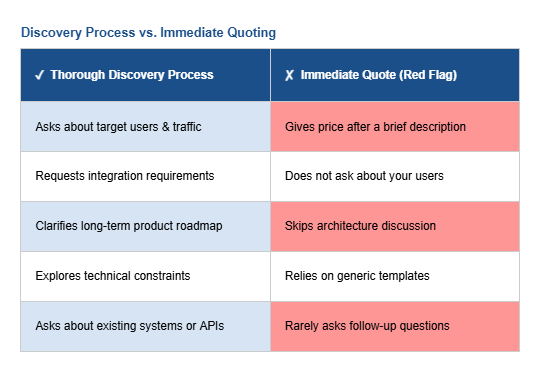
Experienced developers ask a lot of questions before they can estimate a project accurately. A thoughtful team will ask about your target users, your expected traffic, your integration requirements, your timeline, and your long-term plans for the product. These questions help them design the architecture properly and avoid expensive rework later.
When a company produces a quote almost immediately, it often means the scope has not been explored deeply. In some cases, the initial estimate ends up expanding significantly once development begins. A quality team will ask thorough questions before the proposal to save both sides from problems during the project.
What to look for: A structured discovery process with specific, business-focused questions before any proposal is shared.
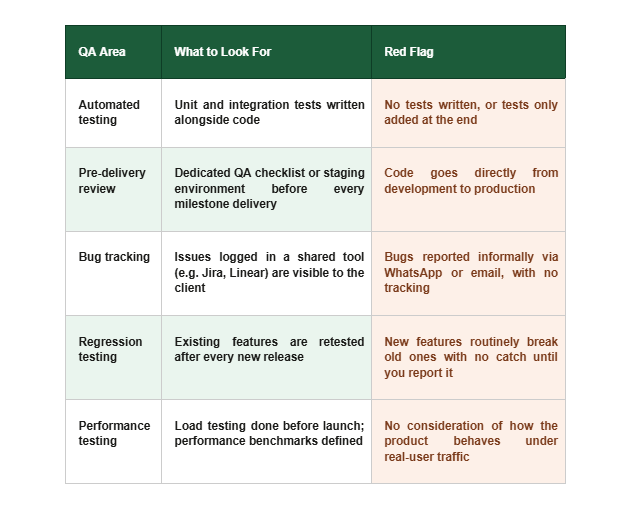
They have no clear testing or quality assurance(QA) process
Building software is not just about writing code; it is also about ensuring that code works reliably under real-world conditions. A professional development company should be able to explain how they test their work.
Unit tests validate that individual functions and components behave correctly. Integration tests check that different parts of the system work together. End-to-end tests simulate real user journeys through the product.
If a development company cannot clearly describe how they test features and handle bugs, that is a concern. Poor testing often leads to poor products with bugs that may surface after launch, often when users are already interacting with the product.
What to ask: "What does your testing process look like before deployment?”
There is no mention of version control or handover.
Professional development teams manage their code using version control systems, most commonly Git. This allows multiple developers to collaborate while maintaining a full history of changes.
As a client, you should have access to this repository during the project. Waiting until the end to receive a compressed folder of files is not standard practice and makes collaboration difficult.
It is also important to understand what happens at handover. A proper handover should include:
- Full access to the code repository
- Documentation (architecture, setup, deployment steps)
- Environment variables and configuration details
- Access to third-party services (e.g., Stripe, Sendgrid)
- Deployment pipeline or hosting setup (e.g., AWS, Vercel, Docker)
Without these, transitioning to a new team or scaling the product later can become unnecessarily difficult. A good company builds with the expectation that other developers may work on the product in the future.
What to ask: "What does your handover process look like, and what documentation will I receive at the end of the project?"
Their pricing or timeline sounds too good to be true
Every founder hopes to find a fast and affordable development company. The reality is that building reliable software takes time and experienced engineers.
When a proposal promises to deliver a complex platform extremely quickly or at a dramatically lower price than other quotes, it is worth examining closely. Often, these offers rely on templates presented as custom work or teams that lack senior oversight.
Rushed development also tends to reduce testing and quality control. The product may launch quickly, but scalability issues might start appearing as soon as real users arrive. This does not mean expensive is always better, but it does mean that if an offer seems dramatically out of step with what others are quoting, it is worth asking why.
Reasonable timelines and transparent pricing are usually a sign that the team understands the complexity of the work involved.
What to ask: "Can you break down the timeline and cost estimate by phase and deliverable?"
Communication is slow or unclear from the start.
How a development company communicates before you sign is usually a preview of how they will communicate during the project. If responses are slow during the sales process, if questions go unanswered, if updates are vague, these may get worse, not better, during the project.
Good teams are clear about how they communicate. They use project management tools to track progress and keep clients informed. They give you visibility into what is being worked on and flag problems early.
Before signing, ask how they handle status updates, what tools they use, and what their typical response time is. A team that cannot answer these questions clearly is one that will leave you guessing throughout the project.
What to look for: Prompt, clear, and professional communication from the very first interaction.
A Simple Technical Due Diligence Checklist for Founders
Before committing to a development company, it helps to pause and review a few practical questions:
- Can they explain why they are recommending this tech stack for your specific project?
- Do they have live, verifiable products in their portfolio?
- Does the contract clearly define deliverables, milestones, and IP ownership?
- Did they ask meaningful questions about your users, goals, and technical requirements before quoting?
- Will you have access to the code repository throughout the project?
- Is their pricing and timeline realistic compared to other quotes you have received?
- Do they have a clear testing and QA process before deployment?
- Will you receive full access to infrastructure, environment variables, and third-party services at handover?
- Are they responsive, clear, and proactive in communication before any contract is signed?
If you can answer yes to all of these, you are in a strong position.
Conclusion
Hiring a development partner is one of the most important decisions in the early life of a product. The technical choices made during those first months can influence how easily the product evolves for years afterwards.
A poor partnership does not just waste money. It can slow down momentum and force founders to rebuild work that should have been done correctly, at the first instance. Many founders learn this lesson only after a painful experience.
Technical due diligence is simply a way to reduce that risk. By asking thoughtful questions and paying attention to early signals, founders can distinguish between teams that are genuinely prepared to build the product and those that are not.
Frequently Asked Questions
1. Why should founders perform technical due diligence before hiring a development company?
Technical due diligence helps founders verify whether a development company actually has what is required to build a reliable product. It reduces the risk of delays, poor code quality, scalability issues, and ownership disputes later in the project.
2. What questions should I ask a website development company before hiring them?
Some important questions include:
· Why are you recommending this technology stack for my project?
· Can you share live URLs of products you’ve built?
· What does your development and testing process look like?
· Will I have access to the code repository during development?
· How will the project be handed over when it is complete?
These questions help you evaluate both technical competence and transparency.
3. What should be included in a professional development contract?
A well-structured development contract should include:
- Clear project scope and deliverables
- Defined milestones and timelines
- Payment stages tied to progress
- Intellectual property ownership terms
- Handover and documentation expectations