
Ese Ekienabor
How Tech Adoption Is Fueling the Next Unicorns
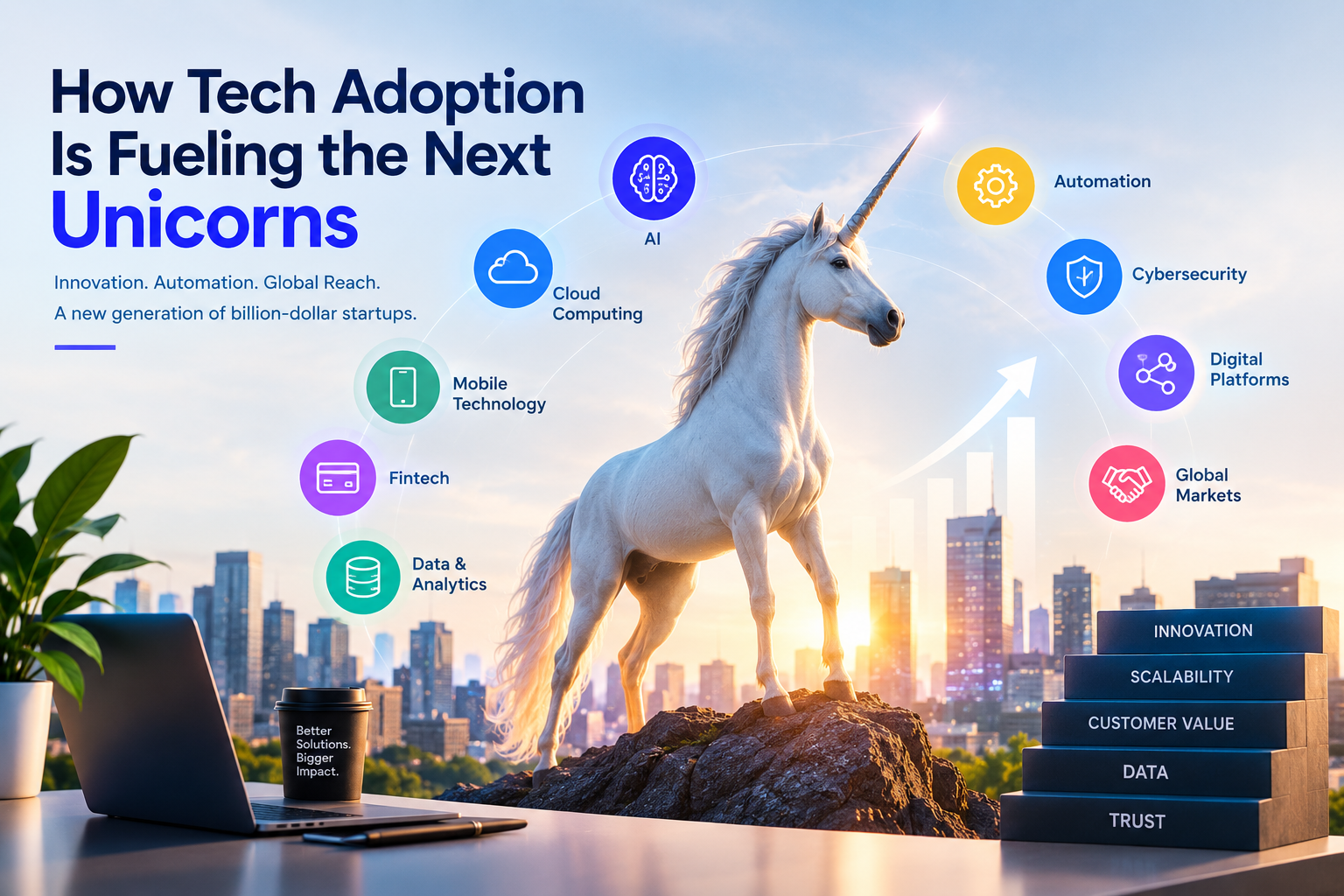
The global business environment is being transformed by rapid technological adoption. Cloud computing, artificial intelligence (AI), mobile technology, fintech, data analysis, automation, cybersecurity, and digital platforms are changing how businesses are created and scaled. These technologies are also creating opportunities for a new generation of unicorns — privately held startups valued at more than US$1 billion.
Unlike traditional businesses, technology-driven startups can often reach millions of customers without investing heavily in physical infrastructure. A small team can develop a digital product, use cloud infrastructure, reach customers through online platforms, and expand into international markets. This ability to scale quickly has made technology one of the most important drivers of startup growth.
Artificial intelligence is currently at the centre of this transformation. McKinsey's 2025 global survey found that 88 percent of respondents reported regular AI use in at least one business function, compared with 78 percent the previous year. The survey also found that 62 percent of organizations were experimenting with AI agents. These developments suggest that AI is moving rapidly from experimentation toward practical business applications.
The next generation of unicorns will therefore emerge from companies that can combine technological innovation with real customer needs, scalable business models, and effective execution.
Artificial Intelligence and the New Unicorn Economy
AI is arguably the most powerful technology shaping future unicorn creation. Businesses increasingly use AI for customer service, marketing, software development, healthcare, finance, cybersecurity, logistics, research, and administration.
The major opportunity for startups is that many business processes are expensive, repetitive, and data-intensive. Entrepreneurs can use AI to automate these processes and provide services more quickly and cheaply — for example, software that helps hospitals organize medical records, assists financial institutions with fraud detection, or enables companies to automate customer support. Instead of simply selling technology, these businesses can sell measurable improvements in productivity and efficiency.
The growth of AI-native companies is particularly important. These startups are designed around AI from the beginning rather than adding AI to an existing product, which lets them redesign workflows and business models around artificial intelligence rather than bolting it on.
AI Agents and Automated Work
Traditional software generally requires users to perform tasks themselves. AI agents can increasingly perform multiple steps on behalf of users — interpreting instructions, retrieving information, interacting with other software, and completing defined workflows.
This creates opportunities for companies providing AI agents across several functions:
- Sales — lead qualification, outreach, and follow-up
- Customer service — resolving tickets end-to-end, not just routing them
- Recruitment — screening, scheduling, and initial candidate assessment
- Finance — reconciliation, reporting, and fraud flagging
- Procurement — vendor comparison and purchase-order workflows
- Legal research — document review and precedent search
- Software development — code generation, testing, and debugging
McKinsey reported in 2025 that 23 percent of surveyed organizations were already scaling an agentic AI system somewhere within their organization — an early sign that businesses are exploring software capable of performing increasingly complex work.
Future startups may therefore sell not only software but also digital labour. Customers could pay an AI company to complete specific business processes rather than simply providing access to an application.
Cloud Computing and Lower Barriers to Entry
Cloud computing has significantly reduced the cost of creating technology companies. Previously, startups needed to purchase servers, networking equipment, storage systems, and other infrastructure. Cloud services let companies rent these resources according to demand, creating a flexible model where startups can begin with limited resources and expand as their customer base grows.
Cloud computing also enables international expansion — a company can develop a product in one country and make it available to customers around the world without establishing physical infrastructure in every market. This scalability is one of the reasons technology companies can grow faster than many traditional businesses.
Data as a Strategic Asset
Digital companies collect information from transactions, applications, websites, connected devices, and customer interactions. When properly analyzed, this information can help companies understand customers, predict demand, identify fraud, improve products, and make better decisions. AI increases the value of this data because machine-learning systems can identify patterns and relationships within large datasets.
Successful startups can create a valuable feedback loop:
More customers → more data → better products → more customers
However, companies must protect customer information and comply with privacy and data-protection requirements. Poor data management can damage customer trust and create significant financial and legal risk.
Automation and Lean Companies
Automation is changing the relationship between company size and revenue. Traditional businesses often need large numbers of employees to serve growing customer bases; technology can automate many activities, including customer support, accounting, marketing, software testing, and infrastructure management. This allows startups to operate with relatively small teams while serving large markets — a new generation of lean unicorns capable of producing substantial economic value without enormous workforces.
Human employees remain important, but their roles increasingly focus on creativity, strategy, leadership, relationships, and complex decision-making while technology handles repetitive activities.
Fintech and Digital Financial Services
Financial technology has created another major source of unicorn opportunities. Digital payments, mobile banking, online lending, digital insurance, investment applications, and embedded finance are changing traditional financial services — allowing companies to provide financial services without relying entirely on physical branches or legacy infrastructure.
This is especially important in emerging markets, where many consumers and small businesses have historically faced barriers to formal financial services. Mobile technology and digital payments can bring millions of people into the digital economy, and entrepreneurs can then build additional services around payments, credit, insurance, savings, and business finance.
Mobile Technology and Emerging Markets
Smartphones have become powerful entrepreneurial platforms. Mobile applications let startups provide healthcare, education, transportation, commerce, entertainment, financial services, and agricultural solutions directly to consumers — particularly significant in Africa and other emerging markets.
Entrepreneurs there can develop solutions for local challenges while building products that may eventually be adapted for international markets. Technology therefore gives emerging economies an opportunity to become sources of innovation rather than simply consumers of imported technology.
Digital Platforms and Network Effects
Marketplaces connect buyers and sellers, payment platforms connect consumers and merchants, and technology ecosystems connect developers with customers. Platforms can benefit from network effects — the dynamic where a product becomes more valuable as more people use it:
- More buyers on a marketplace attract more sellers, and vice versa
- More merchants accepting a payment method make it more useful to consumers
- More developers building on a platform make it more attractive to end users, which in turn attracts more developers
However, technology alone does not guarantee platform success. Companies must build trust, maintain quality, create effective incentives, and solve the coordination problems that come with bringing different groups of users together.
Cybersecurity and Digital Trust
As technology adoption increases, cybersecurity becomes increasingly important. Companies depend on cloud systems, applications, databases, digital identities, and connected devices — all of which can become targets for cyberattacks. This creates opportunities for cybersecurity startups specializing in threat detection, identity management, cloud security, privacy, application protection, and AI security.
Trust becomes particularly important as AI adoption increases. Businesses need systems that protect data, reduce errors, prevent unauthorized access, and provide appropriate human oversight. A technology company that fails to protect its customers can quickly lose its reputation and market value.
Technology Must Solve Real Problems
Technology adoption alone does not create a unicorn. A startup may have impressive technology but fail because customers don't need the product or aren't willing to pay for it.
The most successful future unicorns will connect technology directly to valuable outcomes — reducing costs, increasing productivity, improving customer experiences, accelerating decision-making, or creating services that were previously unavailable. McKinsey's research shows that although AI adoption is widespread, many organizations are still experimenting with the technology, which means there remains a major opportunity for startups that can help businesses move from experimentation to measurable results.
The important question is therefore not simply "What can this technology do?" but "What valuable problem can this technology solve?" Technology on its own can't function effectively; humans must think smart and use it to solve meaningful problems. AI should make the work faster, not replace the function.
Technology Convergence
The next generation of unicorns may emerge from the combination of several technologies:
- AI + robotics — automating physical work
- Fintech + AI — improving financial decision-making
- Healthcare + AI + wearables + telemedicine — combining medical data with continuous monitoring and remote care
- Logistics + sensors + cloud + AI + automated vehicles — building self-optimizing supply chains
This convergence creates opportunities that don't exist when technologies are considered separately. Entrepreneurs who understand how different technologies can work together may therefore have a significant advantage.
Challenges
Despite the opportunities, technology-driven startups face serious challenges:
- Rising competition, as cloud computing and AI become widely accessible commodities rather than differentiators
- Expanding regulation, particularly around data protection, AI governance, cybersecurity, and digital finance
- Excessive valuation, as investor enthusiasm can push startups to valuations difficult to justify against actual revenue and profit
- Talent scarcity, since advanced technology still requires skilled people across engineering, business strategy, product development, cybersecurity, and responsible technology governance
Successful unicorns will therefore need more than innovative products — they'll need strong leadership, sustainable economics, customer trust, and responsible management.
Conclusion
Technology adoption is creating the foundation for the next generation of unicorns. AI is enabling new products and automated workflows. Cloud computing is reducing infrastructure costs. Mobile technology is expanding access to global markets. Fintech is transforming financial services. Data is becoming a strategic asset, while automation is allowing companies to operate with leaner teams.
The greatest opportunities will belong to entrepreneurs who use these technologies to solve important problems at scale. The next unicorns may not necessarily be the companies with the most sophisticated technology — they'll be the companies that understand customers, identify valuable problems, develop scalable solutions, and use technology to deliver better outcomes.
The emerging formula is therefore:
Technology + Innovation + Problem Solving + Scalability + Data + Trust = The Next Unicorn
As technology becomes cheaper, more accessible, and more powerful, entrepreneurs in both developed and emerging economies will have greater opportunities to build global companies. The future unicorn economy will be increasingly digital, automated, data-driven, and global. Its most successful companies will be those that transform technological possibilities into sustainable economic and social value.
FAQs
What is the main reason AI-native startups reach unicorn status faster than traditional SaaS companies? AI-native companies build their product and business model around automation from day one, rather than adding AI features to an existing tool. This lets them price around outcomes and usage instead of per-seat licenses, and their growth isn't capped by how many human users they can onboard — it scales with how many workflows they can automate. Traditional SaaS still grows primarily by adding users; AI-native companies can grow by taking on more of the work itself.
How do regulatory pressures impact AI unicorn valuations? Expanding rules around data protection, AI governance, and algorithmic accountability raise compliance costs and can slow product rollout in regulated industries like healthcare and finance. Investors increasingly price this in, favoring startups that build compliance and auditability into the product early over those that treat regulation as an afterthought. Regulatory clarity can also work the other way — once rules are settled, it can accelerate adoption by giving enterprise customers confidence to buy.
Can a startup become a unicorn on AI alone, without a clear business model? Rarely sustainably. Investor enthusiasm can push valuations ahead of revenue in the short term, but the article's central point holds: technology has to solve a real, paid-for problem. Startups that can't show a path from impressive technology to a viable business model tend to see valuations correct once funding conditions tighten.
Which industries are most likely to produce the next wave of unicorns through technology convergence? Healthcare (combining AI, wearables, and telemedicine), fintech (combining AI with financial decision-making), and logistics (combining sensors, cloud computing, AI, and automation) are the sectors most frequently cited as fertile ground — because each involves large, inefficient, data-rich processes that stand to gain the most from combining multiple technologies rather than adopting them one at a time.
References
McKinsey & Company. (2025). The state of AI in 2025: Agents, innovation, and transformation.
McKinsey & Company. (2025). The state of AI: How organizations are rewiring to capture value.
McKinsey & Company. (2025). Agents, robots, and us: Skill partnerships in the age of AI.
CB Insights. (2025). State of AI 2025 Report.
CB Insights. (2025). The Global Unicorn Club: Private Companies Valued at $1 Billion or More.