
Nebolisa Ugochukwu Benedict
Nebolisa Ugochukwu Benedict is a Software Engineer specializing in React, TypeScript, and Node.js, he architects high-performance systems that transform core concepts into production-ready products. He eliminates architectural friction by handling the development lifecycle end-to-end, ensuring that every layer of the stack is built for type safety and structural integrity.
Article by Gigson Expert
The role of the front-end developer has undergone a total transformation in the last few years. While the field once focused on simple interface implementation, it now requires a high level of system orchestration and architectural foresight. Modern web applications are no longer isolated pages but complex distributed systems that must be reliable, accessible, and performant. In this environment, a senior developer is less of a code monkey and more of a technical director who ensures that the user interface aligns with broader business objectives and technical standards. This shift is driven by the rise of generative AI, which has simplified routine coding tasks, thereby increasing the value of human judgment and structural design.
As the industry moves forward in 2026, the definition of seniority is expanding to include proficiency in automated workflows and ethical oversight. Organizations are increasingly looking for professionals who can manage the integration of autonomous agents into the development life cycle without compromising on security or user experience. This report explores the core technical and human skills necessary to lead front-end engineering in this new era.
Advanced Technical Mastery and Language Depth
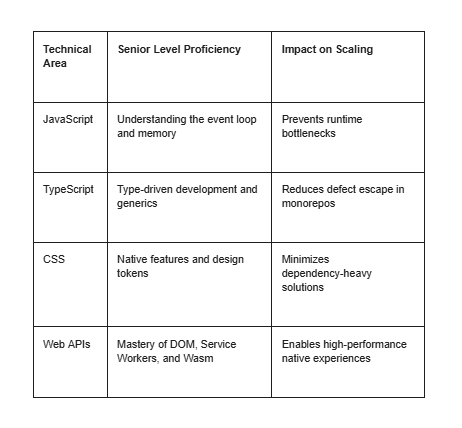
The foundation of any senior role is a deep understanding of core web technologies. Knowing JavaScript is no longer enough. You must understand the engine's behavior, including closures, scopes, and memory management. Fluency in the event loop and asynchronous patterns like microtasks is essential for optimizing performance in large-scale applications.
TypeScript mastery is a baseline requirement, not a secondary skill. Using advanced types and generics ensures code remains robust during complex refactoring cycles. In 2026, the focus has shifted from manual coding toward directing AI tool output. Research from Forbes indicates that software development is 81% exposed to transformation by AI, meaning developers are moving from doing the work to validating and contextualizing it.
Scalable Component Architecture and Design Systems
The ability to design reusable, platform-oriented capabilities distinguishes senior developers from their peers. Modern front-end development is dominated by component-based frameworks like React, Vue, and Svelte. A senior developer must architect these components using principles like Atomic Design to ensure they are testable and reusable.
Design systems are no longer just about aesthetics. They are cross-functional products that include tokenized styling and accessibility baked into every component from the start. Manual accessibility auditing remains a core human senior skill that AI frequently fails at. While AI can generate accessible markup, validating proper screen reader behavior, keyboard navigation flows, and ARIA implementation requires human expertise and user testing.
The integration of these systems often involves micro-frontends in enterprise environments. This approach allows different teams to develop and deploy independent modules, improving development velocity but increasing state management complexity. Many teams are moving toward Spec Driven Development, which uses formal specifications as the source of truth to guide both human and AI efforts.
Performance Engineering and Architectural Observability
Performance is a critical business metric that directly impacts user engagement and revenue. Senior developers must measure, analyze, and optimize Core Web Vitals to maintain a competitive edge. This includes implementing lazy loading, code splitting, and memoization to prevent unnecessary re-renders. You must define performance budgets and enforce them using automated tooling in CI/CD pipelines.
Managing complex distributed systems requires architectural observability. This allows engineering leaders to visualize how application architectures evolve and identify technical debt before it leads to system failure. According to Harvard Business Review, without this visibility, teams risk architectural drift and reduced agility.
Avoiding Integration Hell:
Integration hell is a systemic condition where the cost of connecting mismatched AI and software components exceeds the cost of the components themselves. To prevent this, senior developers should follow this checklist of consistent integration patterns:
- Establish consistent API contracts across all services
- Use schema validation for all data exchanges
- Implement integration tests before production deployment
- Document integration patterns in a shared repository
- Use feature flags to safely roll out integrations
- Monitor integration points with observability tools
Following these patterns ensures your stack remains cohesive as complexity grows.
Human Skills and Ethical Leadership in 2026
As automation takes over routine tasks, human-centred skills have become more valuable. The most successful developers combine technical depth with emotional intelligence. Harvard Business Review highlights that human strengths like judgment, creativity, and ethical reasoning are the true differentiators in the age of AI.
Mentorship and collaborative leadership are vital. A senior developer leads by creating psychological safety and sharing knowledge effectively. In an environment where 90% of AI implementations fail due to organizational issues, guiding teams through structured approaches provides a significant career advantage.
Essential Human Skills:
- Storytelling: Persuading stakeholders with human narratives rather than just data.
- Critical Thinking: Weighing trade-offs and choosing the right problem to solve.
- Empathy: Understanding the user's needs and the team's challenges.
- Governance: Deciding what should be automated and what requires human touch.
Adapting to the Era of Agentic Automation
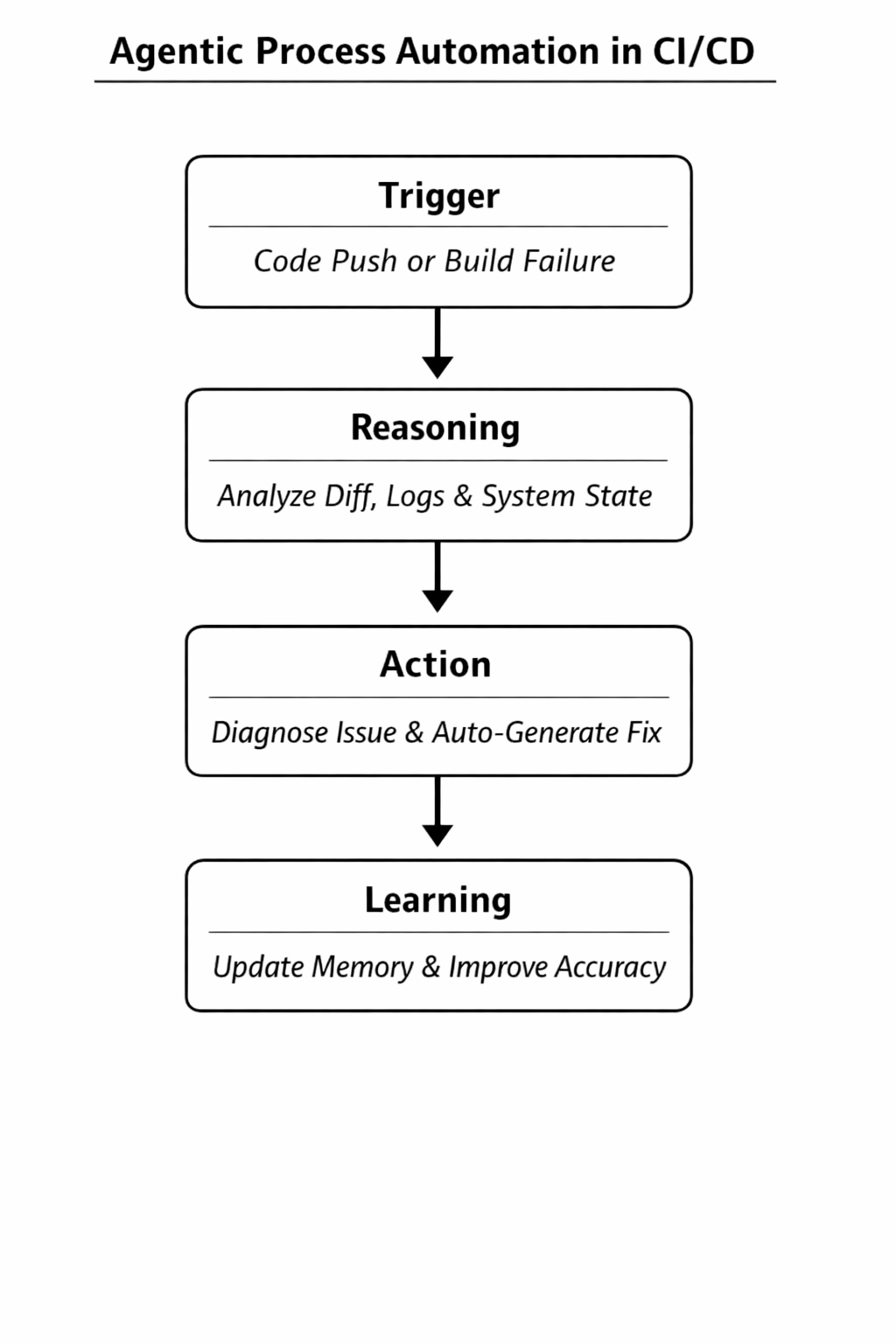
We are entering a period defined by Agentic Process Automation (APA). Unlike traditional automation that follows rigid rules, APA utilizes AI agents that understand context and adapt to changing conditions. For senior developers, this means managing agents that can self-heal and collaborate across systems.
How APA Works:
- Traditional RPA: Rule => Execute (breaks when input varies)
- Agentic Process Automation: Goal => Analyze Context => Adapt => Execute (adjusts to variations, self-corrects errors)
Organizations that succeed treat AI like a new employee requiring continuous training rather than a set-and-forget tool. Senior leaders must focus on process clarity and oversight to ensure these agents deliver measurable results without introducing silent failures at scale.
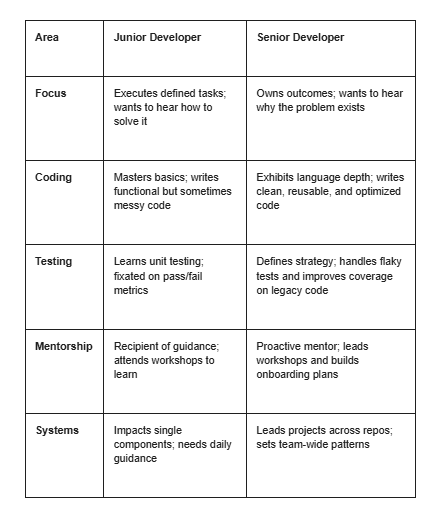
Career Roadmap: Junior vs Senior Responsibilities
Understanding the distinction between junior and senior responsibilities helps clarify your growth path:
Future-Proofing the Development Workflow
Building a resilient career in front-end development requires a commitment to continuous learning and adaptation. This final section provides a strategic roadmap for staying relevant.
Research from MIT suggests that while AI can handle code completion, the hard part of software engineering remains high-level design, strategy, and maintenance. To future-proof your role, you must expand your expertise into adjacent domains like product management, UX research, and business strategy.
Senior developers should aim for a multi-spired skill set, where they have deep technical expertise combined with the ability to translate technical jargon into business value. By embracing new tools and focusing on the human capabilities that machines cannot replicate, you can ensure that your work remains indispensable to your organization. The goal is to evolve from being a person who writes code into a person who decides what to build and why.
Frequently Asked Questions
How do you stand out as a front-end developer with AI being ubiquitous?
To stand out, move from a code executor mindset to that of a technical architect. Master high-level system design, understand the business reasoning behind features, and develop multi-spired expertise in areas like UX design or product strategy. Your value lies in directing AI agents effectively and providing human judgment, ethical reasoning, and creative problem-solving that machines lack.
Why is TypeScript considered essential for senior roles in 2026?
TypeScript provides a formal contract for code behavior, necessary for managing large codebases and multi-team environments. It enables safer refactoring, faster onboarding, and prevents silent behavioral errors that occur in vanilla JavaScript. As AI generates more code, TypeScript's type safety becomes critical for validating AI output.
How is the shift toward Prompt-Driven Architecture redefining the senior developer role?
While junior developers use AI to generate snippets, senior developers use Spec-Driven Development to define the mental model for AI. The skill has shifted from "how to write a function" to "how to define the contract." By providing AI with rigid architectural specs covering state management patterns, prop types, and design tokens, you ensure AI acts as a high-speed contributor following your rules rather than generating inconsistent code.
How does architectural observability help in managing technical debt?
Architectural observability allows teams to visualize and measure how application architectures evolve through the SDLC. This helps engineering leaders identify the root cause of complexity and prioritize remediation of technical debt before it impacts application resiliency. Without observability, teams accumulate debt invisibly until it becomes a critical bottleneck.
What role does accessibility play in distinguishing senior developers?
Manual accessibility auditing is a core human skill that AI frequently fails at. While AI can generate accessible markup, validating proper screen reader behavior, keyboard navigation flows, and ARIA implementation requires human expertise. Senior developers ensure accessibility is not just checked by automated tools but validated through real user testing and manual audits.