
Shallom Fabunmi
Using Agentic AI to Manage Spiky "Japa" Seasonal Travel Bookings and Visas
Imagine running a travel agency that normally handles 100 customer enquiries a day. Then September approaches.
Suddenly, students are asking about visas, flights, accommodation and travel dates. Some need help understanding a document requirement. Others want the cheapest flight to the UK. A few have already booked and need help after an airline changes their schedule.
The problem isn't necessarily a lack of customers. It is having enough people to handle all of them well.
This is where agentic AI could change how travel agencies manage seasonal demand.
Rather than using AI simply as a chatbot that answers questions, a travel agency could use an AI agent to coordinate parts of a customer's journey from finding visa information to comparing flights while leaving sensitive decisions and high-impact actions to humans.
What makes an AI Agent Different?
A chatbot generally responds to whatever a customer asks. An agent can take a broader goal and work through several steps to achieve it.
Consider a student saying:
“I've been admitted to a university in the UK. My course starts in September. I need help sorting out my visa and flight.”
A useful agent could first identify what information is missing, retrieve relevant visa guidance, create a checklist and then search for flights based on the student's preferences. It could also remind the student about outstanding tasks.
This doesn't mean giving the AI complete freedom. Anthropic's guidance on building effective agents recommends starting with the simplest architecture that solves the problem, rather than adding unnecessary complexity.
For a travel agency, that could mean one central agent connected to a small number of approved tools.
A Practical Travel-Agent Setup
The architecture could look something like this:
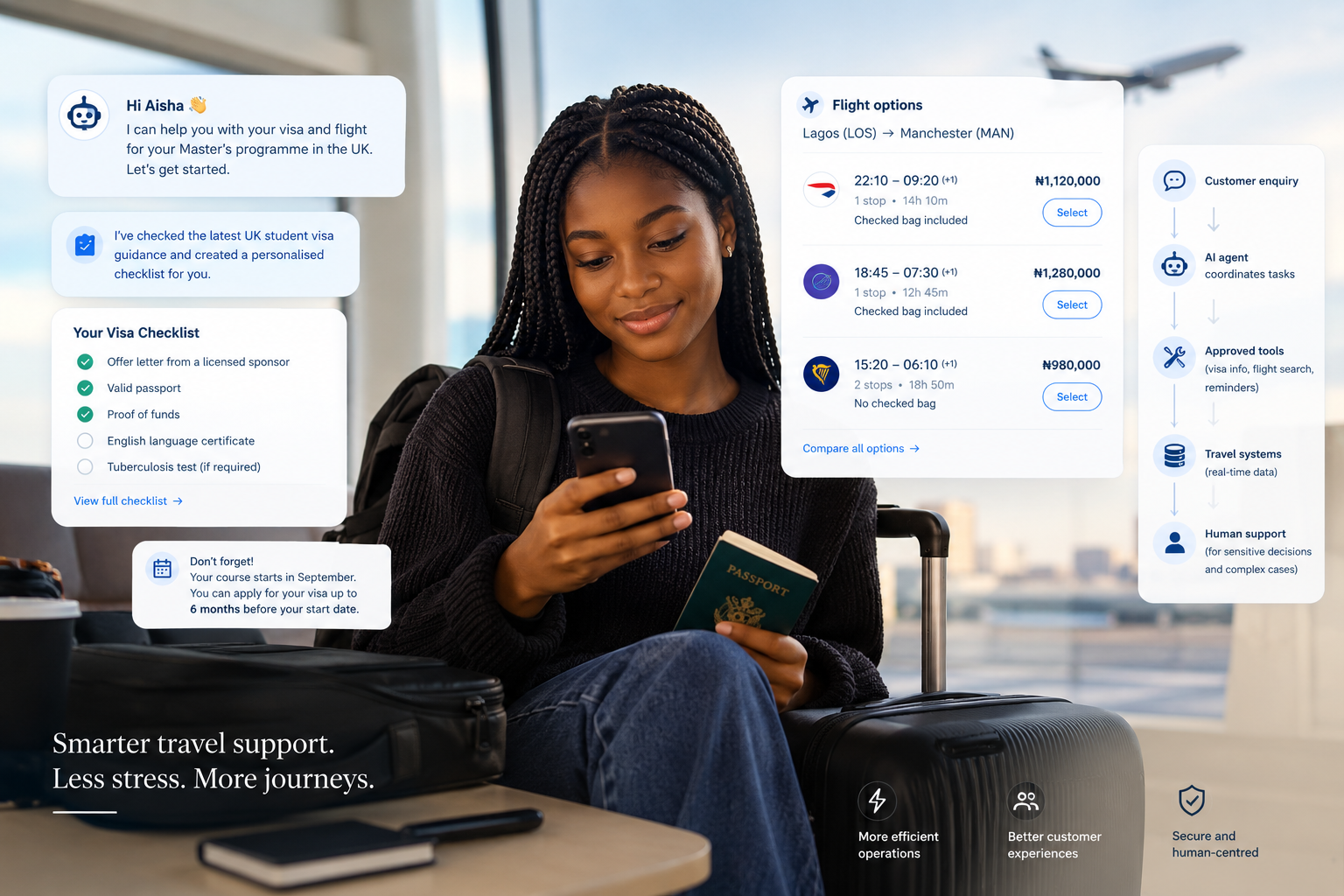
Customer → AI agent → approved tools → travel systems → human support
The agent handles the conversation and coordinates tasks. External systems provide information that changes in real time.
For visa questions, the agent could use a retrieval system containing approved information from official immigration sources. This is important because visa requirements can change, and a language model should not be treated as the final authority.
For example, the current UK Student visa guidance says applicants applying from outside the UK can apply up to six months before their course starts. It also outlines requirements such as having an offer from a licensed student sponsor and meeting the relevant financial and English language requirements. The agent could turn that information into a personalised checklist instead of making the student search through several pages herself.
From Visa Questions to Flight Bookings
Once the visa process is underway, the next headache is usually the flight.
A student might tell the agent:
“Find me an affordable flight from Lagos to Manchester in September. I don't want more than one stop, and I need a checked bag.”
They can translate that request into specific search criteria and send it to an authorised flight-search service.
This is where airline distribution technology becomes useful. IATA's New Distribution Capability (NDC) is a standard designed to improve communication between airlines and travel sellers and provide richer airline offers for comparison.
The AI shouldn't invent prices or availability. It should retrieve actual offers, compare them against the customer's requirements, and explain the differences.
For instance, the cheapest flight might have two stops and no checked baggage. Another option might cost slightly more but include baggage and have only one stop.
Instead of simply saying, “This is the cheapest,” the agent can explain the trade-off.
The final purchase should also require confirmation. Searching for a flight is one thing; spending a customer's money is another.
The workflow becomes:
Search → Compare → Recommend → Customer confirms → Book
That small approval step prevents an innocent misunderstanding from becoming an expensive mistake.
The system could also limit how many times an AI agent calls an external service. If a flight API stops responding, the agent shouldn't keep calling it indefinitely. It should retry within defined limits and then escalate the problem.
Where humans stay in control
The most important part of this system may be knowing what not to automate.
An AI can answer general questions, organise documents, search flights and send reminders. It shouldn't independently decide whether someone qualifies for a visa. It also shouldn't make an expensive booking without the customer's approval.
The same principle applies to security.
A travel agent could potentially have access to passports, dates of birth, visa documents and payment information. Giving one AI unrestricted access to all of that creates unnecessary risk.
OWASP's 2026 Top 10 for Agentic Applications identifies security risks associated with systems that can plan, use tools and take actions, while NIST's Generative AI Risk Management Profile provides a framework for managing risks throughout an AI system's lifecycle.
The proposed system should therefore use limited permissions, authentication, access controls, secure data handling and audit logs. Every important action should be traceable.
If an unusual case arises, the agent should stop and pass it to a person.
Aisha's journey
Let's put all of this together.
Aisha, a Nigerian student, has been admitted to a Master's programme in the UK. She tells the AI agent that her course begins in September and asks for help with her visa and flight.
The agent retrieves current official visa information and creates a checklist. It identifies what Aisha has completed and what still needs attention.
Next, it searches flights based on her budget, preferred date, baggage requirements and numb
References
Anthropic — Building Effective Agents
https://www.anthropic.com/engineering/building-effective-agents
IATA — New Distribution Capability (NDC)
NIST — Generative AI Risk Management Profile
OWASP — Top 10 for Agentic Applications 2026
https://genai.owasp.org/resource/owasp-top-10-for-agentic-applications-for-2026/�
GOV.UK — Student Visa
https://www.gov.uk/student-visa/overview