.jpeg)
Modurotolu Olokode
Modurotolu Olokode is a seasoned full-stack engineer with a decade of experience in building scalable applications. Modurotolu is passionate about solving problems with technology and loves sharing insights that empower developers to make informed technical decisions.
Article by Gigson Expert
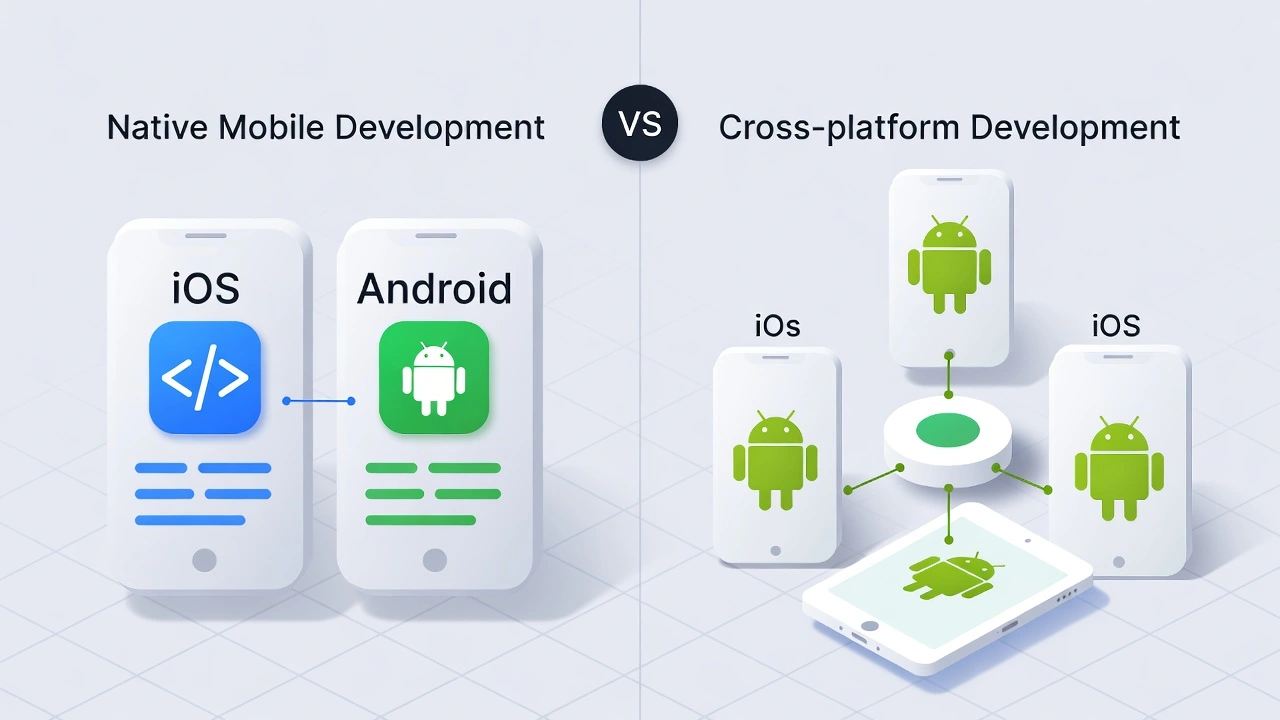
Choosing between cross-platform and native mobile development is one of the most consequential decisions teams face when building mobile applications. This choice affects development speed, user experience, maintenance costs, and long-term scalability. Understanding the trade-offs helps teams make informed decisions aligned with their specific goals and constraints.
The Native Development Approach
Native development means building separate applications for each platform using platform-specific languages and tools (Swift/Objective-C for iOS and Kotlin/Java for Android). Because the code runs directly on the operating system, native apps benefit from optimized performance, fluid interactions, and immediate access to platform features.
Example: Direct access to platform APIs for iOS and Android
iOS Native - Swift
import UIKit

class ProductViewController: UIViewController {
    @IBOutlet weak var productImageView: UIImageView!

    override func viewDidLoad() {
        super.viewDidLoad()
        // Direct access to iOS-specific APIs
        productImageView.layer.cornerRadius = 12
    }
}
Android – Kotlin
import android.os.Bundle
import androidx.appcompat.app.AppCompatActivity

class ProductActivity : AppCompatActivity() {
    override fun onCreate(savedInstanceState: Bundle?) {
        super.onCreate(savedInstanceState)
        setContentView(R.layout.activity_product)
        // Direct access to Android-specific APIs
    }
}
Native development excels in performance and platform-consistent UX. However, maintaining two separate codebases doubles development effort, increases staffing requirements, and slows feature parity across platforms.
Cross-Platform Development Solutions
Cross-platform frameworks allow teams to write most of the application logic once and ship to both iOS and Android. React Native and Flutter are two leading options, each with different approaches.
React Native
Uses JavaScript/TypeScript and renders native components. Ideal for teams with web experience.
React Native example: shared UI with native rendering
<Image source={{ uri: 'product.jpg' }} style={styles.image} />Flutter
Uses Dart and its own rendering engine, offering highly consistent UI and excellent animation performance.
Flutter example: consistent design across platforms
Image.network('product.jpg')Code reuse typically falls between 70–95%, depending on how much platform-specific integration is required.
Performance Considerations
Native apps still lead in performance for computationally heavy tasks, advanced animations, and deep hardware integration. To smooth the transition into this section:
Performance becomes a differentiator when applications exceed basic UI interactions or rely heavily on system capabilities.
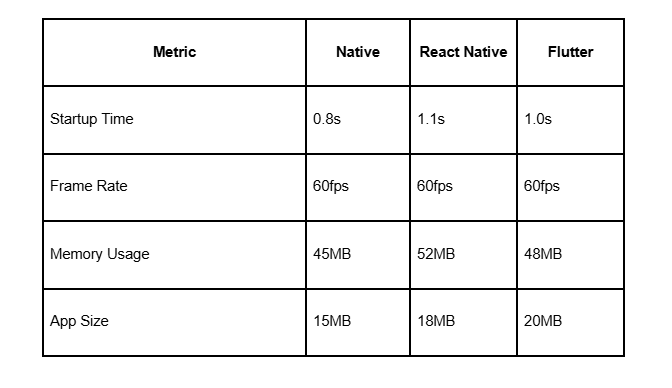
For typical business applications (e-commerce, social feeds, content delivery), modern cross-platform frameworks deliver performance that is effectively indistinguishable to end users. Banking apps with sophisticated security requirements, augmented reality applications, or high-performance games typically benefit from native development.
Performance Comparison (Typical Business App)
Development Speed and Cost Analysis
Cross-platform development significantly reduces effort because teams implement features once. A feature requiring 10 days across two native platforms may take 6–7 days in Flutter or React Native. Teams can also operate with fewer developers since skills overlap across platforms.
Past industry experiences vary: Airbnb reverted to native to handle complex edge cases, while Discord, Shopify, and Bloomberg successfully use React Native at scale. Many companies, like Instagram, blend both approaches; native for core experiences and cross-platform for fast-moving features.
User Experience Trade-offs
Native development naturally adheres to platform conventions, creating an experience users instantly recognize. Cross-platform frameworks can achieve similar results but often require extra tuning.
React Native - Platform Specific Example
// React Native: simple platform adjustment
padding: Platform.OS === 'ios' ? 12 : 16
Apps where polish and performance define user satisfaction, like gaming, photography, high-end consumer apps, often benefit from native development. Enterprise or internal applications prioritize functionality and speed of delivery, making cross-platform ideal.
Maintenance and Long-term Considerations
Cross-platform maintenance is more efficient: bug fixes, feature updates, and security patches apply across both platforms simultaneously. However, framework stability and third-party ecosystem maturity vary. Native ecosystems remain the most stable, with predictable API deprecations and extensive library support.
Cross-platform frameworks rely on community packages, which may lag behind OS updates or require custom native modules for advanced functionality.
Common Scenarios: What to Choose?
Several factors should guide your decision:
Choose Native For…
- A high-performance fintech app requiring strict security and biometrics
- A photo or video editing tool with heavy processing
- A consumer app where flawless motion and platform-true interaction matter
- An app needing immediate access to brand-new iOS/Android features
Choose Cross-Platform For…
- A 3-month MVP where speed and iteration matter
- An internal enterprise tool with standard CRUD features
- A content or e-commerce app requiring frequent updates on both platforms
- Teams with limited budget or primarily web developers
Hybrid Approach
Many successful companies use both strategically; native for core, performance-critical features, and cross-platform for secondary screens or features that change frequently.
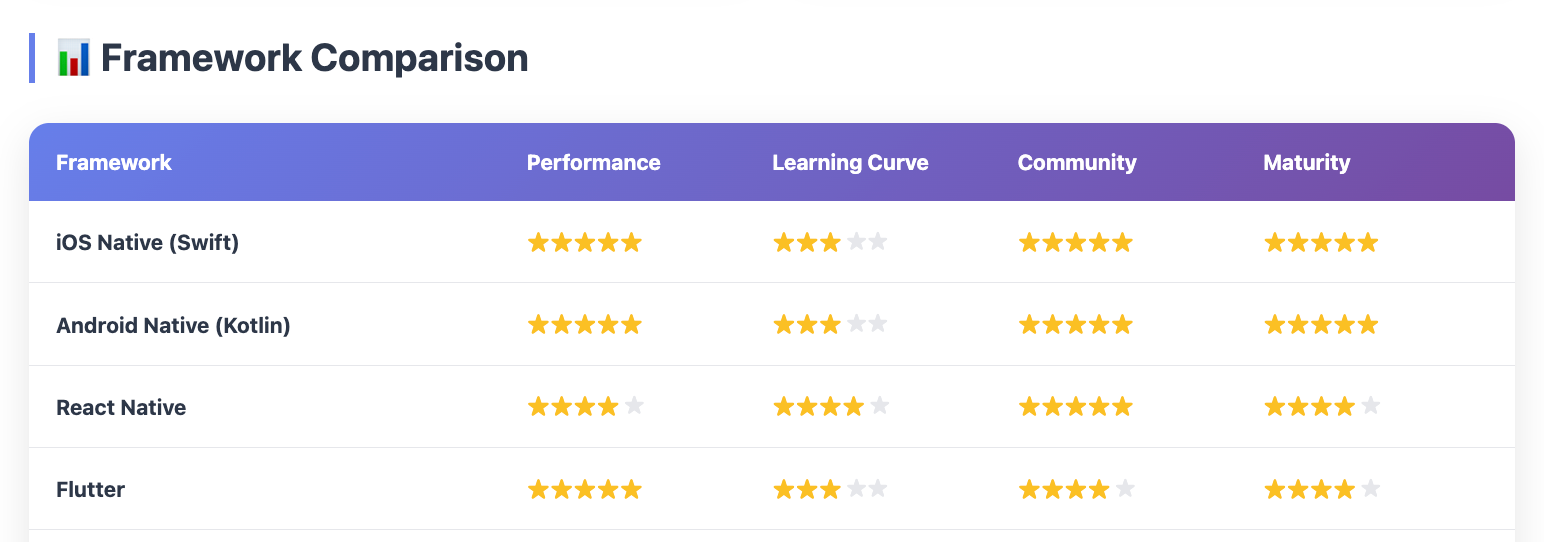
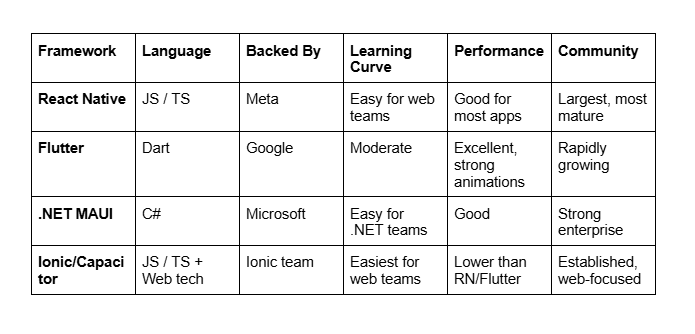
Framework Comparison
Conclusion
There is no universally “correct” approach. Cross-platform frameworks have matured enough to handle the majority of applications with strong performance and substantial development savings. Native development remains unmatched for performance-critical, animation-heavy, or deeply integrated experiences.
Some organizations benefit from a hybrid strategy; using native where it matters and cross-platform where it accelerates delivery.
The best choice ultimately depends on team expertise, budget, performance needs, and long-term product strategy.
Frequently Asked Questions
Q: Can cross-platform apps access device hardware like cameras and GPS?
A: Yes, modern cross-platform frameworks provide APIs for virtually all device hardware. React Native, Flutter, and MAUI all support camera, GPS, accelerometer, biometrics, and other sensors. Some advanced features may require platform-specific code bridges.
Q: Do cross-platform apps perform worse than native apps?
A: For most business applications, the performance difference is negligible. Cross-platform apps can achieve 60fps animations and responsive interactions. Performance-critical apps like games or photo editors may benefit from native development, but typical apps perform well on both approaches.
Q: Can I switch from cross-platform to native later?
A: Yes, but it requires significant investment. Companies like Airbnb made this transition, essentially rebuilding their apps. The business logic and architecture can often be preserved conceptually.
Q: How do app store approval processes differ?
A: App store submission is identical regardless of development approach. Apple and Google don't distinguish between native and cross-platform apps during review. The same guidelines, requirements, and approval times apply.
Q: What about Progressive Web Apps (PWAs) as an alternative?
A: PWAs are viable for content-heavy applications with limited hardware requirements. They're instantly accessible without installation but lack offline capabilities, push notifications, and hardware access that native and cross-platform apps provide. Consider them for supplementary experiences rather than primary mobile strategies.

.webp)