
Israel Alagbe
A Full-Stack Engineer with 8+ years of experience building scalable, secure and high-performance systems. I work across modern frontends, backend APIs and distributed event-driven microservice architectures, and I’m comfortable taking products from concept to production. I focus on reliability, maintainability and solid user experience, and I work well in cross-functional, remote teams.
Article by Gigson Expert
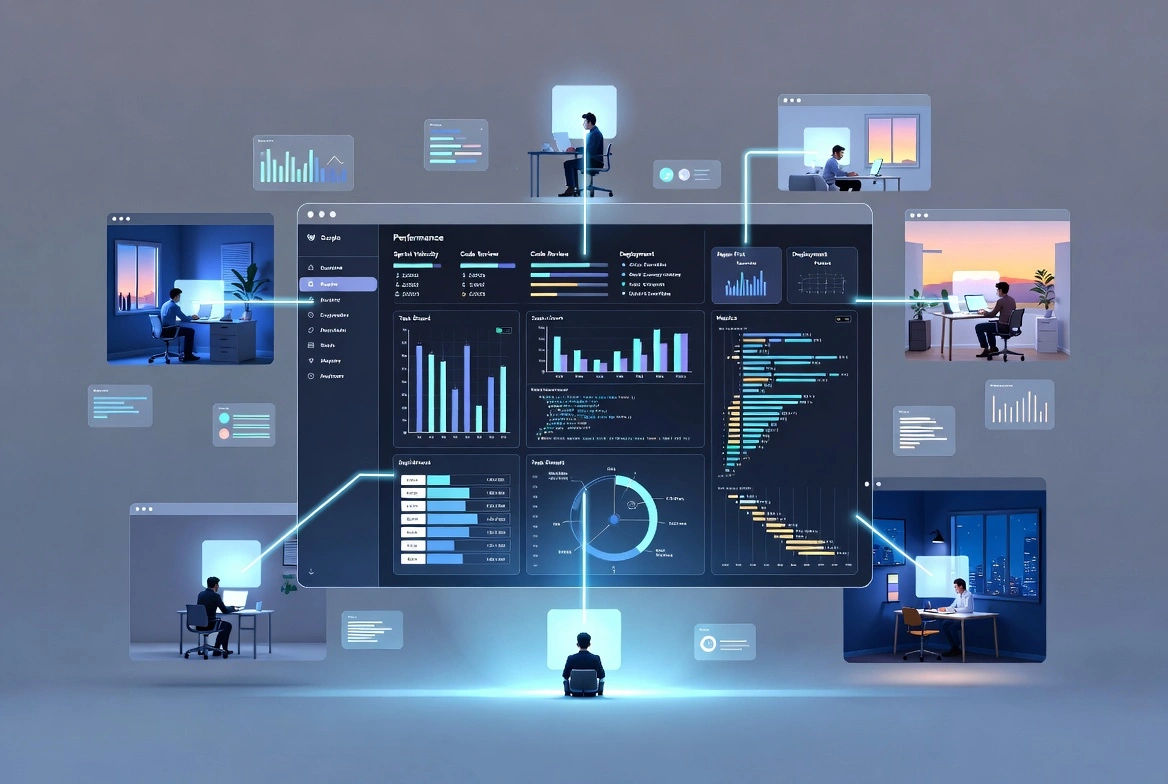
In the current tech landscape, the "office" is no longer a physical coordinate; it is a digital ecosystem. For companies looking to scale, building a distributed engineering team is a strategic necessity to access global talent and ensure 24/7 operational continuity.
Success in this model requires a fundamental shift: moving away from subjective interpretations and toward a culture of Radical Transparency, Clear Ownership, and Data-First Accountability.
1. The Asynchronous-First Communication Hierarchy
In a distributed environment, real-time chat is a tool, not a constant requirement. Implementing an Async-First policy prevents notification fatigue and protects "Deep Work" blocks.
- The Single Source of Truth (Documentation): This is where every final decision, system design, and all 'how-to' guides must live (e.g., Notion, Confluence, or Zoho Learn). If it's not written down here, it didn't happen. This allows anyone, anywhere, to find information without waiting for a live meeting.
- Structured Tasks (Project Management): Use platforms (like Jira, Linear, or Monday.com) to turn big ideas into small, clear, trackable work items “tickets”. Each ticket must have enough detail (logs, references to the relevant documentation) so the person doing the work can start and finish without needing to interrupt anyone for questions.
- Quick Questions and Alerts (Chat): This is for fast, non-urgent questions and automated system messages e.g., Slack or Zoho Cliq. Use chat mainly to signal that documentation is ready for review, not for making major decisions.
- Live Meetings (Video Calls): This is used for urgent problems that need immediate solving, complex brainstorming that is hard to do in writing, or sensitive personal conversations. These should be a last resort, and every meeting must be summarized in writing afterward so others can find the information later.
- Onboarding Workflow (New Hires): This model requires a dedicated, data-first approach for new hires. The first 30 days must focus on converting every step, from access requests to small, measurable feature contributions, into searchable documentation and verifiable data points, rather than relying on synchronous shadow sessions.
2. High Trust and Radical Autonomy
A distributed team thrives when engineers are empowered to act as "Owners" rather than "Executors."
- Autonomy: Increase autonomy by removing the need for permission on basic tasks. If documentation and guardrails are clear, engineers can ship code independently.
- Transparency: Promote an "Open by Default" culture. Meeting notes and project roadmaps should be accessible to everyone. When everyone has the same information, they can make better independent decisions.
- Flexible Hours & Mandatory Overlaps: Judge the team by output, not by their "active" dot on Slack. However, maintain a 3-hour mandatory overlap window (for example: 12 PM to 3 PM UTC) for rapid-fire collaboration.
- Selective Management: Avoid the "Micromanagement Trap." If an individual struggles, allocate a dedicated mentor or sub-team lead to manage them specifically, rather than imposing restrictive rules on the entire team.
3. Ownership Structure by Default
Ownership is the antidote to apathy. Every part of the system must have a "Face" responsible for its health and evolution.
- Domain Ownership: Each person is the primary owner of a specific portion of the work (such as a specific microservice, the landing page UI, or the API integration). They are responsible for its code quality, documentation, and uptime.
- The Ownership Mindset: Owners do not just "fix bugs"; they anticipate them. They are expected to propose improvements to their domain without being asked.
- Hierarchical Ownership: Some individuals serve as Lead Owners (Team Leads). While they own their own tasks, they are also "Owners of the Outcome" for others, reporting on the collective progress of their sub-team to senior leadership.
4. Data Over Thoughts and Feelings
In a remote setting, subjective "vibes" about progress lead to misalignment. Thoughts and feelings can lie; data does not.
- Objectivity Over Subjectivity: Feelings are influenced by bias and mood. Data (such as commit frequency, test pass rates, and ticket velocity) remains constant.
- Data-Backed Conflict Resolution: Disagreements should be settled via performance benchmarks or scalability metrics, not by who is more "passionate."
- Eliminating "The Guess": Avoid phrases like "I feel like this is almost done." Replace them with: "I have completed 4 out of 5 sub-tasks, representing 80% of the ticket data."
5. Precision Tracking: Task-Based Check-ins & Estimates
Predictability is the bridge between autonomy and accountability. Use a proactive, task-based check-in rhythm:
- The 50% Progress Rule: For any ticket with a defined time estimate, a check-in is required at the halfway mark. If a task is estimated at 8 hours, a status update is required at the 4-hour mark, followed by a final status at the 8-hour due time.
- Time-Limited Tickets: Every Jira ticket or Story Point must have an estimated time limit. This allows leadership to calculate team velocity accurately and identify when a task is spiraling before it is too late.
6. The Daily Stand-up: Yesterday, Today, Blockers
The Daily Stand-up is the heartbeat of a healthy team. To respect different time zones, the structure must be rigid and data-focused:
- The Core Questions: Every member reports on:
- What did I do yesterday? (Historical data).
- What am I doing today? (Planned focus).
- Are there any blockers? (Risk data: identifying where the team needs help).
- The Format: Best handled asynchronously via a dedicated Slack or Zoho Cliq channel at the start of each person’s local day.
Conclusion
Building a distributed engineering team is about building a high-trust, ownership-driven, and data-first culture. By leveraging tools like Slack, Zoho, and Google Meet, and enforcing an "Async-First" mindset with proactive check-ins, you remove the bottlenecks of physical offices. When every thought is converted into a digital copy and ownership is clearly defined, your team can build faster and stay focused longer.
FAQs
Q: How do we handle urgent production bugs in an async-first environment?
Establish a clear "Escalation Path." Critical bugs trigger an immediate synchronous response via Slack Huddles or Google Meet. This is the only time "Flexible Hours" are paused for an immediate "All Hands" response.
Q: Won't time-based check-ins feel like micromanagement?
No. When framed as a "safety net," it supports autonomy. If an individual consistently fails these data-based milestones, they are moved to a sub-team with a mentor for closer guidance, leaving the rest of the team to work autonomously.
Q: Why use Google Meet if we already have Slack Huddles?
Slack Huddles are for informal "shoulder taps." Google Meet is superior for structured meetings requiring advanced transcription, large groups, or high-fidelity screen sharing for deep-dive code reviews.
Q: What if the "Mandatory Overlap" is impossible due to time zone gaps?
For 12-hour differences, split into regional sub-teams. Ensure sub-team leads (Lead Owners) have a 1-hour overlap for handovers, relying on high-quality documentation to bridge the rest.
Q: What happens if an Owner makes a mistake?
We use Blameless Post-mortems. We analyze the data of the failure and update the automated guardrails (CI/CD) to ensure it cannot happen again. Ownership means taking responsibility for the fix, not taking the "blame."
Q: How do we prevent the "always-on" burnout feeling?
Encourage "Digital Boundaries." Outside of the mandatory overlap window and on-call shifts, no one is expected to respond. The 50% check-in rule ensures progress is known, so no one has to "ping" an engineer after hours.
Q: How do we scale this as the team grows from 5 to 50?
Break into sub-teams. Each sub-team has its own Lead Owner who reports up. This keeps communication loops small and ensures that the "mentor" system for struggling individuals does not overwhelm senior leadership.