
Israel Alagbe
A Full-Stack Engineer with 8+ years of experience building scalable, secure and high-performance systems. I work across modern frontends, backend APIs and distributed event-driven microservice architectures, and I’m comfortable taking products from concept to production. I focus on reliability, maintainability and solid user experience, and I work well in cross-functional, remote teams.
Article by Gigson Expert
The decision between a monolithic and a microservices architecture is one of the most critical, and often debated, choices an engineering team faces. It’s rarely about which is “better,” but which is right for your current stage of growth. The transition from one to the other is a challenging and often under-estimated journey.
What is Monolith Architecture?
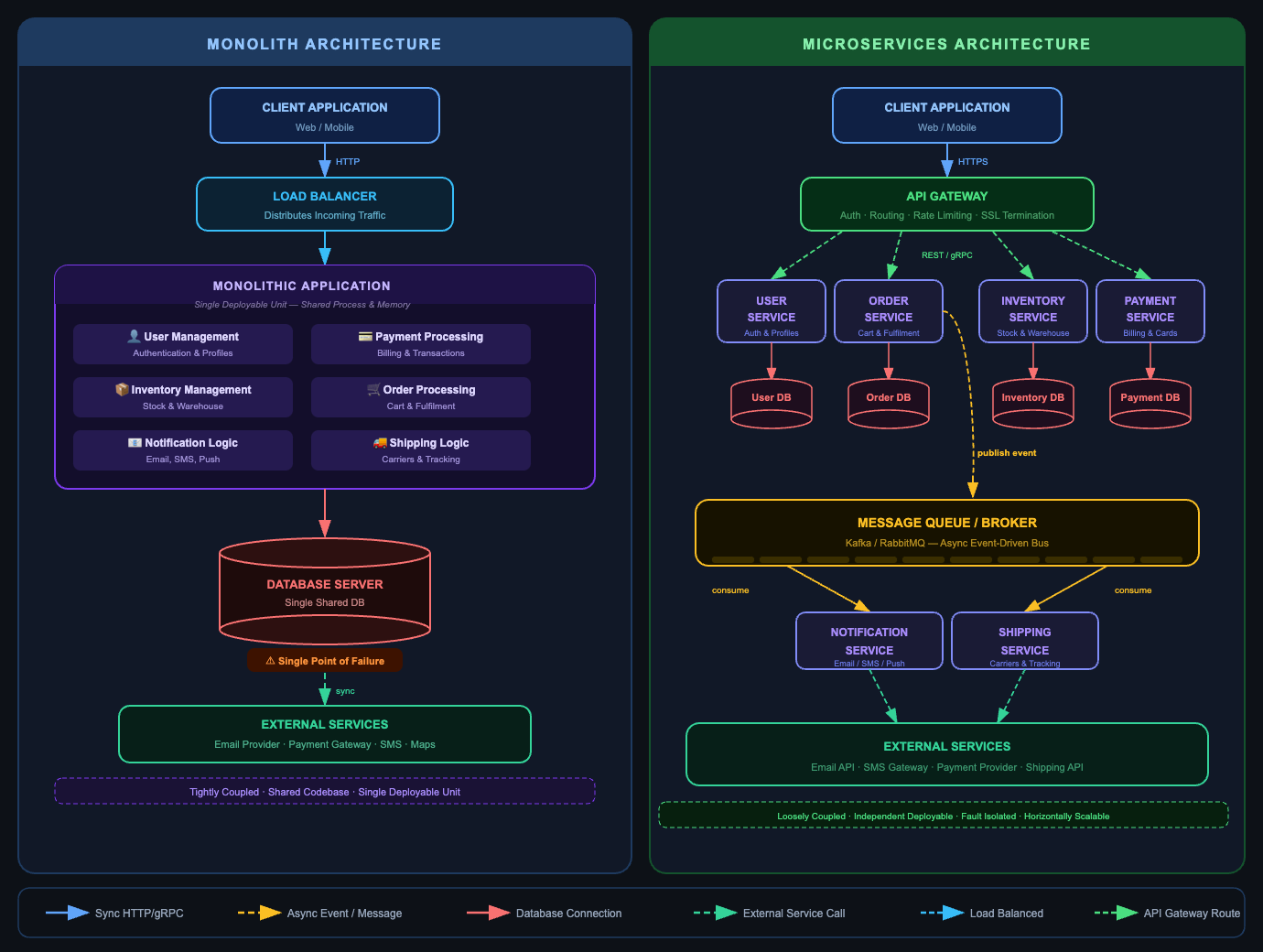
A Monolith is a traditional architectural style where the entire application, including the user interface, business logic and data access layers is packaged as a single, large, indivisible deployment unit. All components are tightly coupled, meaning they share the same codebase, memory space, and often a single database.
What is Microservice Architecture?
Microservices architecture structures an application as a collection of small, autonomous services. Each service is built around a specific business capability, is independently deployable and can be developed using different programming languages (polyglot) and data storage technologies. The system I worked on at Deel was built using a microservices architecture to ensure scalability.
Architectural Diagrams of Monolith vs Microservice
Why Microservices Over Monolith?
The shift to microservices is usually driven by issues related to scale, team structure, and maintenance.
- Team Size & Structure (Organizational Scale): Ideal for large organizations (100+ engineers) where small, autonomous teams (5-8 members) are structured around business domains. This structure minimizes cross-team dependencies and communication bottlenecks.
- Traffic & Scale (Elasticity): Essential for applications requiring massive scale and high throughput (millions of users or requests/day). Microservices enable independent horizontal scaling, meaning only resource-intensive services (e.g., search or payment) are scaled up, optimizing cloud costs and handling unpredictable traffic spikes efficiently.
- Kind (Application Complexity): Best for highly complex applications with rapidly evolving functionality and clear, distinct business capabilities.
- Technology Freedom (Polyglot): Allows teams to choose the optimal programming language, framework, and database technology for each specific service, enhancing performance and developer efficiency.
- Deployment: Enables faster, independent deployment. A bug fix or feature release in one service does not require redeploying the entire system, accelerating the CI/CD pipeline and reducing risk.
Why Monolith Over Microservices?
Monoliths are often a superior choice for small projects or early-stage startups:
- Team Size & Structure (Organizational Simplicity): Perfect for small teams (up to 0-30 engineers) that need maximum coordination and minimal overhead. The structure is often organized by technical layers (frontend, backend) or a single feature track.
- Traffic & Scale (Simplicity): Suitable for applications with low to moderate traffic or predictable, uniform load. Scaling is simpler initially, focusing on vertical scaling (buying a bigger server), which is less costly than setting up the complex orchestration required for microservices.
- Kind (Application Stage): Best for new projects or MVPs where the priority is rapid feature delivery and achieving product-market fit.
- Development & Testing: Everything runs in one process, making local development, end-to-end testing and debugging straightforward without needing distributed tracing or mock services.
- Operational Overhead: Requires far less complex tooling for monitoring, logging, and deployment in the beginning, minimizing the reliance on specialized DevOps expertise.
Cost Analysis: The Hidden Price Tag
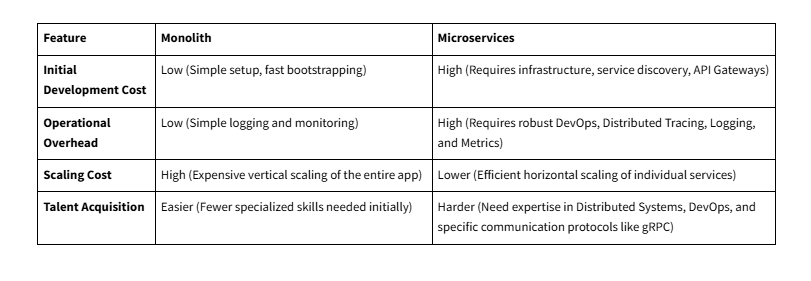
The hidden cost of microservices is complexity. Without a deep understanding of Distributed Systems, the microservices architecture can become a "Distributed Monolith", a system with all the complexity of microservices but none of the benefits.
Essential Tech Stacks to Use
The choice of technologies in a distributed system must support independent development and high-speed communication.
- API Communication: Use gRPC for internal service-to-service communication due to its high speed and efficiency with binary serialization, and use REST or GraphQL for public-facing client APIs.
- Containerization & Orchestration: Docker for containerizing services and Kubernetes for orchestrating them are essential for managing scale and deployment.
- Messaging/Event Streaming: Use Apache Kafka for high-throughput event sourcing and log aggregation, and RabbitMQ for reliable background task queuing and complex routing in microservices.
- Core Backend Frameworks: Common choices include Node.js (excels in concurrent loads), Spring (Java), Django (Python), and Laravel (PHP).
Advice: Start with a Monolith
The most important lesson for any startup or new project is to start with a well-structured Monolith (often called a Modular Monolith). This approach allows the team to focus on the business domain and product-market fit without wrestling with the initial complexity of a distributed system.
Only transition to microservices when:
- Organizational Scaling: Your team has grown to the point where smaller, independent teams are necessary, and coordination becomes a bottleneck.
- Technical Scaling: Specific parts of the monolith are genuinely blocking performance or need vastly different resources/technology.
By starting with a monolith, you can use the Strangler Fig Pattern to incrementally break out services (like the payment processing service in Node.js) only when necessary, avoiding the costly mistake of a premature, over-engineered microservices disaster. I have personal experience in breaking out a monolith into micro-services.
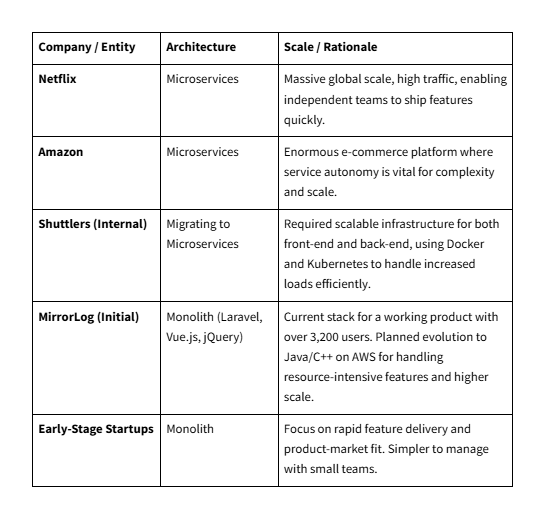
Examples of Companies Using Microservice vs Monolith and Their Scale
Conclusion
The architecture you choose is a product of your current organizational size, technical requirements, and strategic goals. The real lesson of moving from monolith to microservices is that it is fundamentally a shift in culture and operational complexity before it is a shift in code. Microservices offer unparalleled scale and team autonomy, but demand expert DevOps, robust observability (logging, monitoring, tracing), and a commitment to handling distributed system failures. Choose the simplest path that meets your needs today, and only introduce complexity when the cost of scaling the monolith exceeds the cost of managing the microservices.
Frequently Asked Questions (FAQ)
What is a Distributed Monolith?
It’s a failed microservices implementation where services are deployed separately but remain tightly coupled through synchronous calls or shared data, creating all the complexity of distribution without the benefit of autonomy.
Should I share a database between microservices?
No. Sharing a database reintroduces tight coupling, undermining the core principle of service autonomy. Each service should own its data.
How do microservices communicate reliably?
They use various protocols: synchronous (REST, gRPC) and asynchronous (Message Queues like RabbitMQ, or Event Streaming like Kafka).
What is Event-Driven Architecture (EDA)?
An architectural pattern where microservices communicate by producing and consuming events (state changes). It helps decouple services and is critical for high-scale systems.
What is the Strangler Fig Pattern?
A methodology for incrementally replacing a monolithic application by gradually peeling off functionality into new microservices, leaving the monolith to "wither" over time.
Why is gRPC better for internal microservices than REST?
gRPC uses HTTP/2 and binary Protocol Buffers (Protobuf), which results in much higher performance, speed, and efficiency compared to REST's text-based JSON over HTTP 1.1, making it ideal for service-to-service communication.
What is Service Discovery?
The process by which one microservice finds the network location of another microservice it needs to communicate with.
How do you handle transactions in microservices?
Traditional ACID transactions are difficult. Instead, patterns like the SAGA pattern are used, which sequence local transactions and use compensating actions to maintain data consistency in case of failure.
What is Observability in the context of microservices?
The ability to understand the internal state of a system from its external outputs, typically achieved through collecting and correlating Logs, Metrics, and Traces.
How does team structure change with microservices?
Teams typically organize around business domains (Domain Ownership) rather than technical layers (frontend, backend). This promotes autonomy and clear ownership of the end-to-end outcome.
Do I need Kubernetes for microservices?
For small-scale microservices, no (Docker Compose might suffice). For high-scale or production systems, Kubernetes is the industry standard for orchestration, managing deployment, scaling, and networking of containers.
When should I choose Kafka over RabbitMQ?
Choose Kafka for high-throughput event streaming, data pipelines, or situations where you need to retain and replay data. Choose RabbitMQ for simple task queuing, complex routing, and low-latency request/response patterns.
Are microservices always more scalable than a monolith?
They offer more flexible scalability. A well-optimized monolith can often outperform a poorly implemented microservices architecture. The advantage is in horizontal elasticity and technology diversity.
What is the most common pitfall in microservices adoption?
Ignoring the operational challenges, specifically the lack of maturity in DevOps practices and observability tooling, leading to systems that are impossible to debug in production.
What is a Modular Monolith?
A monolith whose internal structure is highly decoupled into modules that communicate via clear interfaces. It’s an ideal starting point because these modules can later be easily extracted into independent microservices using the Strangler Fig Pattern.