

Yakubu Bobai Ephraim
A software developer focused more on frontend development with a passion for building scalable web applications and teaching others about modern development tools. Enjoys creating educational content that simplifies complex engineering concepts for developers at all levels.
Article by Gigson Expert
Modern frontend development is evolving rapidly, and the tools used to bundle, optimize, and deliver applications have had to keep up with increasing complexity. While Webpack dominated the ecosystem for nearly a decade, new tools like Vite and Turbopack have emerged with innovative approaches designed to meet modern performance and developer experience expectations. Understanding the differences between these tools is essential for any developer making decisions about performance, scalability, and long-term maintainability of their applications.
This article provides a detailed, practical comparison of Vite, Webpack, and Turbopack from the perspective of a modern developer building real applications. Whether you're working on a small side project, a large enterprise app, or a high-performance Next.js platform, this guide will help you make the right choice.
A Quick Overview (Comparison Matrix)
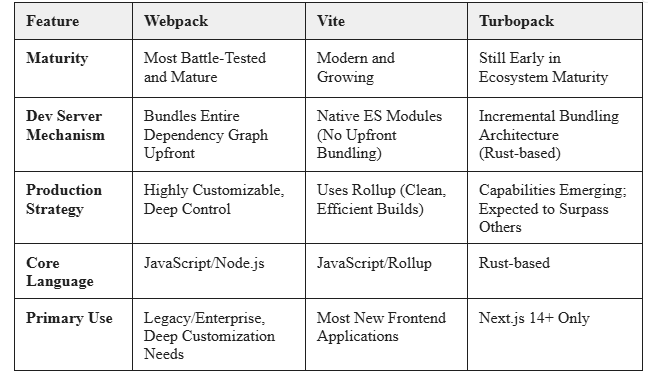
Instead of a wall of text, this matrix provides a quick, scannable overview of the core characteristics of each bundler.
Development Speed
Webpack – Slower Startup
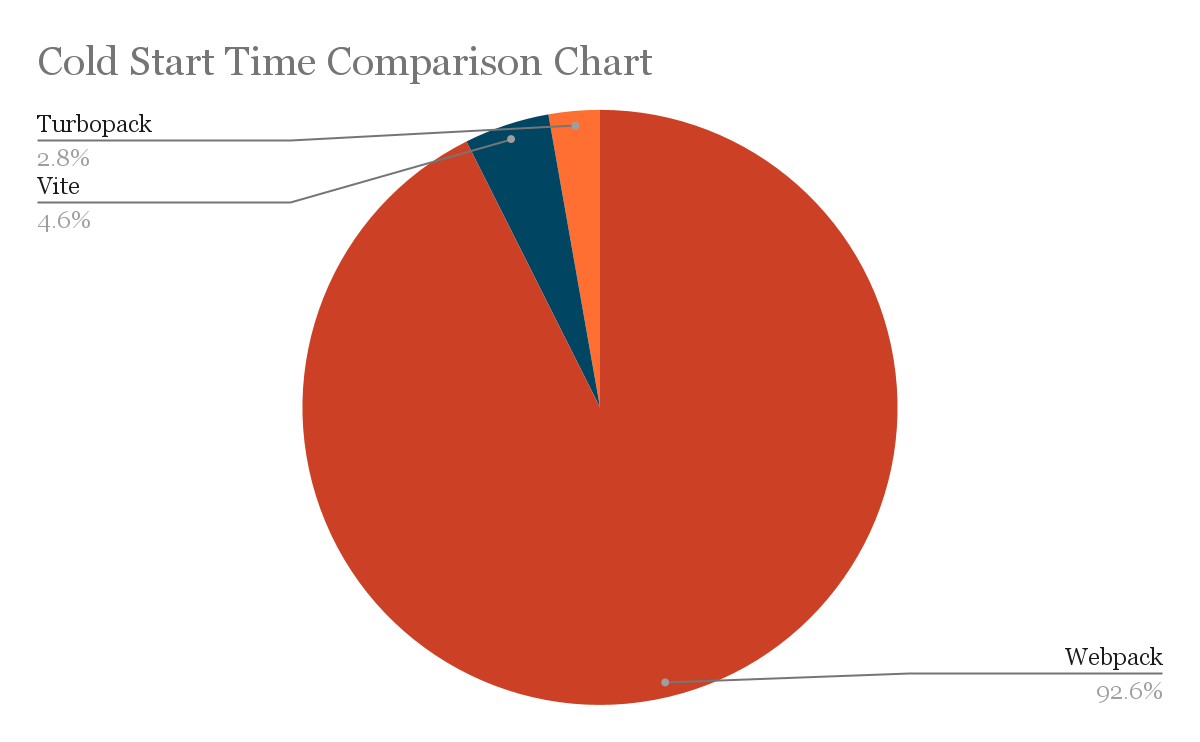
Because Webpack analyzes and bundles the entire dependency graph before starting the development server, startup times can be several seconds or more. As your project grows in size and complexity, Webpack's performance often degrades noticeably.
Vite – Instant Startup
Vite's biggest advantage is its speed. By serving code over ES modules instead of bundling everything upfront, it offers:
- Instant cold start times
- Lightning-fast HMR (Hot Module Replacement)
- Near-zero delays even in large projects
This creates a tight feedback loop for developers, improving overall productivity.
Turbopack – Fastest in Many Cases
Turbopack uses Rust, a systems programming language known for high performance and safety. Because of its incremental bundling architecture, it offers extremely fast HMR and cold start times. In many official benchmarks, Turbopack outperforms Vite by large margins, especially inside Next.js applications.
Important Note: Turbopack is currently deeply integrated into Next.js 14+ and is not a general-purpose build tool for standalone React, Vue, or other non-Next.js applications.
Production Build Performance
Webpack
Webpack's production builds are highly optimized and extremely customizable. For enterprise applications that require strict control over bundling behavior, Webpack remains unmatched due to its deep control over output formats, chunk splitting, and advanced optimizations.
Vite
Vite uses Rollup for production, resulting in clean, tree-shaken bundles that are ideal for modern frontend applications. While Rollup may not offer the same depth of customization as Webpack, it provides more than enough power for the majority of projects and produces builds faster in many cases.
Turbopack
Turbopack's production bundling capabilities are still emerging, but Next.js apps using Turbopack already see significant improvements in build and refresh times. Turbopack is expected to surpass both Vite and Webpack in production performance over time.
Plugin & Ecosystem Support
Webpack – The Most Mature
Webpack has the most extensive ecosystem of plugins and loaders. Whether you're working with legacy libraries, unusual file formats, or advanced functionality, there is almost always a Webpack plugin available.
Vite – Modern and Growing
Vite's plugin ecosystem is growing rapidly, powered by both native Vite plugins and Rollup's plugin ecosystem. It provides a stable and smooth experience for most modern frameworks, supporting React, Vue, Svelte, and SolidJS with official or community-backed plugins.
Turbopack – Still Emerging
While Turbopack is powerful, its plugin ecosystem is still in early development. Most usage today happens inside Next.js 14+, where first-class support is provided. For general-purpose setups outside of Next.js, plugin support is practically non-existent and severely limited.
Configuration & Ease of Use
Webpack
Webpack is known for its complexity. While it offers unmatched flexibility, configuration files can easily become long and difficult to maintain. Beginners often find Webpack challenging due to its steep learning curve.
Vite
Vite is designed to be simple. Most projects require zero configuration, and any additional configuration is minimal and easy to understand. This simplicity makes Vite appealing for beginners and experts alike.
Turbopack
Turbopack offers very little configuration inside Next.js, as the framework handles most settings out of the box. Outside of Next.js, configuration tooling is still developing.
Framework Integrations
Webpack
Webpack integrates with nearly every major framework, especially older versions of React, Vue, and Angular. Many enterprise ecosystems still depend heavily on Webpack.
Vite
Vite is the recommended build tool for modern frameworks such as Vue 3 , Svelte , SolidJS , and React through @vitejs/plugin-react.
Turbopack
Turbopack is deeply integrated into Next.js 14+ and provides the best experience for React Server Components and modern React applications. This makes it ideal for high-performance, server-rendered apps.
When to Use Each
Choose Vite if:
- You want the fastest development experience
- You are building a modern frontend app
- You want minimal configuration
- You need reliable HMR and efficient production builds
Choose Webpack if:
- You're working in a legacy codebase
- Your organization already relies on Webpack plugins
- You need deep customization of the build process
- Your app is extremely large and requires advanced bundling strategies
Choose Turbopack if:
- You’re building with Next.js 14+
- You want future-proof React performance
- You want extremely fast HMR and cold starts
- You want to adopt cutting-edge tooling early
Practical Experiences and Case Studies
Developer Case Study: Migrating From Webpack to Vite
In a recent project involving a medium-sized React application with over 180 components, our development team faced persistent slow build times. Cold starts in Webpack took nearly 20 seconds, and HMR updates regularly took 2-3 seconds. After migrating to Vite, cold starts dropped to under 1 second, and HMR updates became almost instant. This significantly improved productivity and allowed faster iteration on UI and logic.
Personal Experience (Yakubu Bobai Ephraim)
In one of my projects, I worked on a school management dashboard that initially used Webpack. As more features were added, the development server became painfully slow. The time lost waiting for rebuilds started affecting delivery timelines. After switching to Vite, development felt instantly smoother. Hot module replacement was immediate, and debugging became much easier. This experience convinced me that Vite should be the default tool for most new frontend applications I build.
Industry Use Case
A growing fintech startup working with Next.js transitioned from Webpack to Turbopack when upgrading to Next.js 14. Their engineering team reported significant reductions in refresh times, especially when working with React Server Components. The raw performance gains and improved developer workflow justified the switch, despite Turbopack lacking some plugin flexibility.
Conclusion
Each tool shines in different areas:
- Vite is the best overall choice for most new frontend applications thanks to its simplicity, speed, and modern architecture.
- Webpack remains the most customizable and mature solution, ideal for complex enterprise needs and legacy applications.
- Turbopack is the future for Next.js developers and will likely become a dominant tool as the ecosystem matures.
Choosing the right build tool depends on your project’s complexity, scale, and performance requirements. In 2025, Vite provides the best balance of speed and usability, Webpack offers unmatched flexibility, and Turbopack delivers cutting-edge performance for Next.js applications.
Frequently Asked Questions (FAQs)
Can I use Turbopack with Vite?
No. Turbopack and Vite are two separate, competing build tools with fundamentally different architectures. Turbopack is currently integrated deeply into Next.js, while Vite is used for general-purpose application scaffolding and bundling.
Is Webpack dead?
Absolutely not. Webpack is the most battle-tested and mature bundler. It remains essential for legacy codebases, large enterprise applications, and projects that rely heavily on its unmatched plugin ecosystem and deep configuration flexibility.
Why is Vite faster than Webpack during development?
Vite uses native ES modules to serve code during development, meaning it performs no upfront bundling. Webpack, conversely, must analyze and bundle the entire dependency graph before the server starts, leading to slow startup times as the project grows.
Will migrating to Vite break my existing Webpack project?
Migration is generally smooth for modern, well-structured projects, as Vite uses Rollup for production builds. However, it may break if your project relies heavily on Webpack-specific features like complex loaders, legacy libraries, or plugins that don't have a direct Vite/Rollup equivalent. A small to medium refactoring effort is often required, but the productivity gains usually justify the effort.

.webp)