Understanding AI Prompts For Coding Like You’re 5
Learn prompt engineering for developers using the 4 C’s framework to get accurate, production-ready code from AI coding assistants like Copilot and Cursor.


Introduction
The prompt is the single most critical input for any AI coding assistant, serving as the instruction manual that determines the quality, relevance, and accuracy of the generated code. Prompt engineering for developers is the strategic skill of structuring this input to maximize utility, moving beyond simple requests to incorporate four key principles Context, Clarity, Constraints, and Comparison (The 4 C's) which transform the AI from a mere code generator into a specialized, collaborative junior developer capable of handling complex tasks, adhering to specific style guides, and producing production-ready, idiomatic code.
The Secret Ingredient is the Conversation, Not the Code
In the fast-paced world of software development, Artificial Intelligence (AI) coding assistants like GitHub Copilot, cursor, windsurf, or the large language models (LLMs) powering your IDE's chat window have become indispensable tools. They are no longer a novelty; they are a standard part of the modern developer's toolkit.
However, many developers treat these tools like a magic vending machine: insert a general request, and hope for the perfect code snippet. The reality is that the quality of the AI's output is almost entirely dependent on the quality of your input. This input is what we call a prompt, and learning to write an effective prompt is the single most valuable AI skill a developer can acquire.
What is an AI Prompt for Coding? (The 5-Year-Old Explanation)
Imagine you have a super-smart toy that can build anything.
- A "Bad" Prompt:
"Build a house!"The toy might build a tiny doghouse, a brick mansion, or a gingerbread house. It doesn't know what kind of house you need. - A "Good" Prompt:
"Build a house using blue plastic blocks. It needs two windows, a red door, and a chimney on top."Now, the toy has clear instructions and builds exactly what you asked for.
In coding, the prompt is your instruction manual for the AI. It tells the AI:
- Who it is: The expert role it should adopt.
- What you need: The specific output (a function, a class, a regex, a unit test).
- How to do it: The language, framework, constraints, and format.
Mastering this is called Prompt Engineering. It’s the difference between getting a working snippet in 5 seconds and spending 10 minutes debugging useless, hallucinated code.
The Four Pillars of an Effective Coding Prompt
Now that we understand the core concept simply, let's apply this logic to the complex world of real software development.
To ensure your AI assistant is your partner, not your adversary, every high-quality prompt should incorporate four key components. We call these the 4 C’s of Prompt Engineering.
Context: Set the Scene (The "Why")
Context is the backstory. It’s the surrounding information that helps the AI understand the purpose and environment of the code. Never assume the AI remembers or knows your project details.
- Low Context:
"Write a function to fetch user data."- Result: You might get a generic JavaScript fetch API call, but your project is in Python, and the data is in a PostgreSQL database. Useless.
- High Context:
"Act as a Senior Python/Django Developer. I need a function for our REST API endpoint that fetches user data. The database is PostgreSQL. The function should be named get_active_users_data and only select users where is_active=True."- Result: The AI now knows the language, the framework, the database, and the specific requirement, resulting in a relevant, idiomatic Python/Django snippet using the ORM.
Clarity: Define the Task (The "What")
Clarity is about being precise with the task itself. Use action verbs and specify the exact outcome.
- Low Clarity:
"Fix this code and make it fast." - High Clarity:
"Analyze the following JavaScript function and identify a more memory-efficient way to achieve the same result. The current function is causing a memory leak when processing large arrays. Provide the optimized code and a one-paragraph explanation of the complexity improvement."
Constraints: Set the Rules (The "How")
Constraints are the non-negotiables: the programming language, version, format, or security requirements. These guardrails stop the AI from hallucinating or giving you code that simply won't compile or pass your linter.
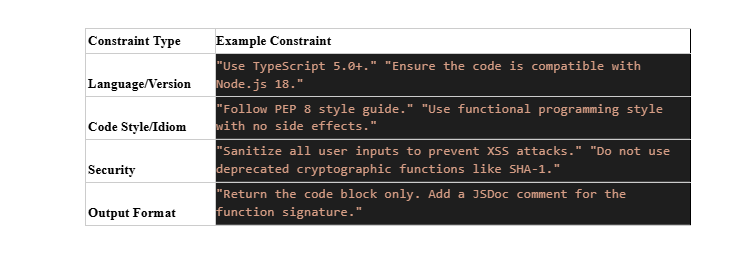
Comparison/Iteration: Refinement (The "Better")
The first output is rarely the best. Great prompt engineering is not a single command, but a conversation. This is where you use follow-up prompts to refine, test, and improve the generated code.
- Initial Prompt:
"Write a class in Java to represent a bank account with deposit and withdraw methods."- AI Response: (Provides a basic class with no error handling.)
- Iteration Prompt 1 (Adding Constraint):
"Great. Now, modify the withdraw method to throw a custom exception called InsufficientFundsException if the balance is too low. Include the class definition for the exception." - Iteration Prompt 2 (Adding Test/Comparison):
"Can you now write a JUnit 5 unit test for the withdraw method? One test must prove that the exception is correctly thrown."
This conversational, iterative approach is the core of modern AI-assisted development. You are leading the AI through a feature development lifecycle.
Practical Prompt Comparison: From Amateur to Expert
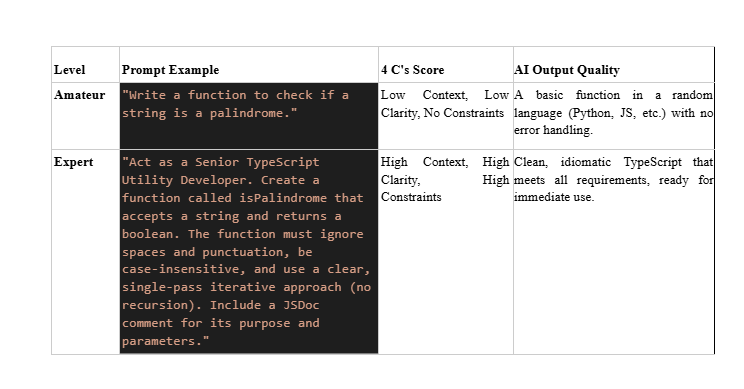
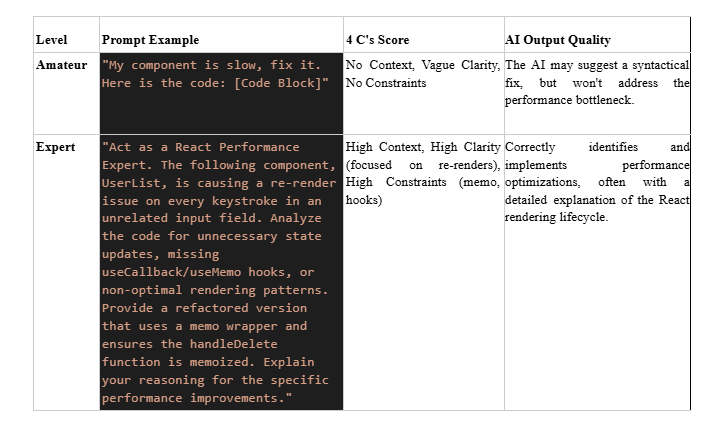
Let's see the 4 C's in action with real-world developer tasks.
Scenario 1: Generating a Utility Function
Scenario 2: Debugging and Optimization
Advanced Prompt Engineering Strategies
Once you have the 4 C's down, you can elevate your prompts with advanced patterns:
The Persona Pattern (Role-Based Prompting)
Explicitly assigning a role dramatically changes the quality of the response, as the AI adopts the associated best practices and terminology.
Prompt: "You are a Senior Security Architect specialized in the OWASP Top 10. Review the following Python function for any vulnerabilities, especially Injection (SQL, Command) and Insecure Design flaws. If a vulnerability is found, explain the risk and provide the corrected, secured code."
The Few-Shot Pattern (Providing Examples)
If you need the output in a very specific, non-standard format, show the AI what you want with one or two examples.
Prompt: "Generate three unit tests for the calculateDiscount function. The format must exactly match our existing Jest pattern:
test('should return 0 when user is not eligible for discount', () => {
  expect(calculateDiscount(200, 'guest')).toBe(0);
});
Now, generate three tests to cover edge cases: maximum discount, minimum purchase amount, and expired code".
Conclusion: Speak to Your AI Like a Colleague
The shift from simply using AI to prompt-engineering with AI is the biggest productivity leap a developer can make today. It's the difference between copy-pasting code that breaks your build and generating code that you can confidently merge after a quick review. Stop asking the AI a general question and start treating it like the brilliant, hyper-specialized colleague it is. Give it a role, clearly define the task, set strict constraints, and use the power of iteration to refine the output.
By mastering the 4 C’s Context, Clarity, Constraints, and Comparison/Iteration, you unlock the true potential of AI as a partner that can write better, faster, and more robust code than you could have created alone. This is not just a coding trick; it is the fundamental skill of the future developer.
Frequently Asked Questions (FAQs)
How do I give the AI my project's existing code without pasting the whole file?
Instead of pasting the entire file (which can waste prompt space), paste only the specific function or class that needs work, along with the relevant dependencies it calls. Use the Context pillar to explain its location and its purpose within the larger application.
What is the best way to prompt the AI for debugging complex errors?
Always follow the 4 C's for debugging:
- Context: State the goal of the broken code.
- Clarity: Paste the complete error message (including stack trace) and the exact line number where it occurs.
- Constraints: Specify the language/library versions (e.g.,
"This is a component in React 18, not 17.") - Comparison/Iteration: Ask the AI to explain its reasoning before providing the fix. If the fix fails, provide the new error message and try again.
How can I ensure the AI’s suggested code meets our security standards?
Use the Persona Pattern and Constraints together. For instance: "Act as an experienced security reviewer. Review the suggested code block and ensure all user inputs are sanitized against XSS. Do not use any deprecated functions. Only provide the secured code and a brief explanation of the vulnerability you mitigated."
Why is the AI hallucinating (generating non-existent functions/syntax)?
Hallucination often happens when the AI lacks Constraints or Context. If you ask for a solution in Python but don't specify the framework (e.g., Django, Flask), the AI may use functions from a mix of libraries. Be specific: "Generate a routing configuration using Flask's Blueprint pattern."